
In modern healthcare, sterile processing departments (SPD) and Central Sterile Supply Departments (CSSD) form the backbone of patient safety. Every surgical procedure depends on one foundational rule: you cannot sterilize a tool that is not impeccably clean. Residual bioburden, blood, tissue, or lipids act as protective shields for harmful pathogens during steam sterilization or autoclaving.
This comprehensive guide explores the science, advantages, workflow, and best practices of ultrasonic instrument cleaning in hospital environments, highlighting how Hisashi Ultrasonic technologies set new benchmarks for clinical hygiene.
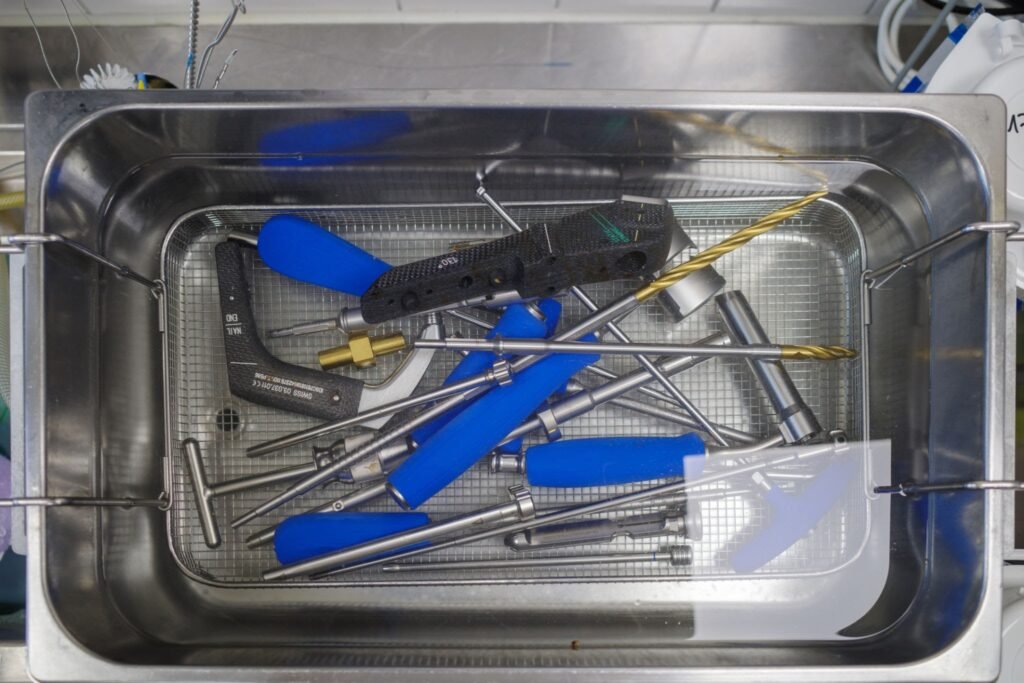
Surgical tools have evolved dramatically over the last few decades. Today, surgeons rely on delicate, complex instruments featuring micro-serrations, box locks, hinges, and long narrow lumens (such as laparoscopic shafts and robotic arms).
Manual scrubbing with brushes poses significant drawbacks:
Human Error and Fatigue: Scrubbing hundreds of instruments per shift leads to inconsistent cleanliness.
Access Limitations: Brushes cannot reach tiny crevices, deep joints, or long internal channels.
Sharps Hazard: Manual handling increases needle-stick injuries and exposure to bloodborne pathogens for CSSD technicians.
Instrument Wear: Abrasive scrubbing wears down delicate protective coatings and blunts sharp edges prematurely.
Ultrasonic cleaning solves these issues by automating the removal of microscopic debris across complex surfaces in a fraction of the time.
The high-frequency generator converts standard electricity into high-frequency electrical signals (typically 37 kHz to 40 kHz). Transducers bonded to the stainless steel tank convert these signals into mechanical sound waves.
Sound waves travel through the cleaning solution, creating rapid cycles of high pressure (compression) and low pressure (rarefaction).
During low-pressure phases, tiny vacuum bubbles form within the liquid solution.
When the pressure cycle shifts to high pressure, these bubbles collapse inward violently (implode). This generates microscopic high-velocity liquid jets (travelling over 250 mph) along with extreme localized temperatures and pressures.
Millions of implosions hit every millimeter of the surgical instrument every second. The physical scrubbing action scrubs away blood, tissue, fat, and bioburden without damaging the instrument’s delicate surface.
To achieve consistent medical-grade results, CSSD teams must optimize four critical variables:
                          [ ULTRASONIC CLEANING TANK ]
                                       │
        ┌──────────────────┬───────────┴───────────┬──────────────────┐
        ▼                  ▼                       ▼                  ▼
  [ Frequency ]      [ Temperature ]        [ Chemistry ]           [ Time ]
  37 kHz - 40 kHz     40°C - 55°C             Enzymatic          3 - 10 Minutes
(Ideal for Med)    (Prevents Coagulation)   pH Neutral Solution  (Based on Soil Level)
Frequency (kHz):
37 kHz – 40 kHz: The gold standard for surgical instruments. It provides robust scrubbing power while remaining safe for delicate stainless steel tools.
80 kHz – 130 kHz: Used for specialized optical components or delicate electronics, providing gentler cavitation with tiny bubbles.
Temperature Control:
Hospital ultrasonic tanks must maintain water temperature strictly between 40°C and 55°C (104°F – 131°F).
Critical Warning: Water hotter than 60°C (140°F) bakes proteins onto steel surfaces, making bioburden nearly impossible to remove. Hisashi Ultrasonic systems feature digital thermal control to prevent accidental protein coagulation.
Detergent Chemistry:
Multi-enzymatic detergents (protease, lipase, amylase) break down blood, lipids, and starches rapidly.
Neutrally balanced pH detergents (pH 6.0 – 8.0) prevent pitting, staining, and corrosion on stainless steel, anodized aluminum, and titanium.
Degassing the Solution:
Fresh water contains dissolved air bubbles that cushion cavitation implosions, reducing efficiency.
Degassing cycles run before cleaning to eliminate dissolved air, maximizing shockwave energy against instrument surfaces.
Following a standardized workflow ensures compliance with international standards such as ISO 15883 and AAMI ST79.
| Step | Task | Key Action |
| 1. Point-of-Use Pre-Treatment | Wipe & Spray | Wipe gross soil in the OR and apply enzymatic transport foam immediately. |
| 2. Decontamination Sorting | Disassemble | Open box locks fully; disassemble multi-part instruments into individual components. |
| 3. Pre-Rinse | Cold Water Flush | Rinse with cold water (<30°C) to wash away loose blood and fluid before tank placement. |
| 4. Degas Tank | Hisashi Ultrasonic Auto-Degas | Run the degas cycle for 5 minutes after filling fresh water and detergent. |
| 5. Load Basket | Avoid Overcrowding | Place heavy tools on the bottom, delicate instruments in sub-trays. Do not stack tools directly on the tank bottom. |
| 6. Ultrasonic Cycle | 37 kHz Cavitation | Run cycle for 5 to 10 minutes at 45°C. |
| 7. Post-Rinse | Deionized (DI) Water | Rinse thoroughly with RO or DI water to remove detergent residue. |
| 8. Inspection & Drying | Magnification & Lint-Free Cloth | Inspect under magnification for cleanliness and dry completely before autoclave packaging. |
Ultrasonic cleaning is not merely an optional extra in medical processing—it is a vital pillar of infection control. By adopting advanced cavitation technologies from Hisashi Ultrasonic, hospitals safeguard their expensive surgical assets, reduce processing times, eliminate cross-contamination risks, and most importantly, keep patients safe.