
Precision engineering, electronic fabrication, automotive assembly, and medical device manufacturing in the National Capital Region (NCR) demand absolute particulate and oil-free cleanliness. As industrial hubs like Sector 63, Sector 80, Greater Noida, and the Yamuna Expressway corridor expand rapidly, traditional manual washing and solvent degreasing fail to meet strict quality benchmarks.
A single residue layer of cutting fluid, polishing compound, or carbon dust can cause paint peeling, electrical short circuits, or critical hydraulic seal failures. Modern manufacturing plants require advanced, high-throughput automated cleaning infrastructure.
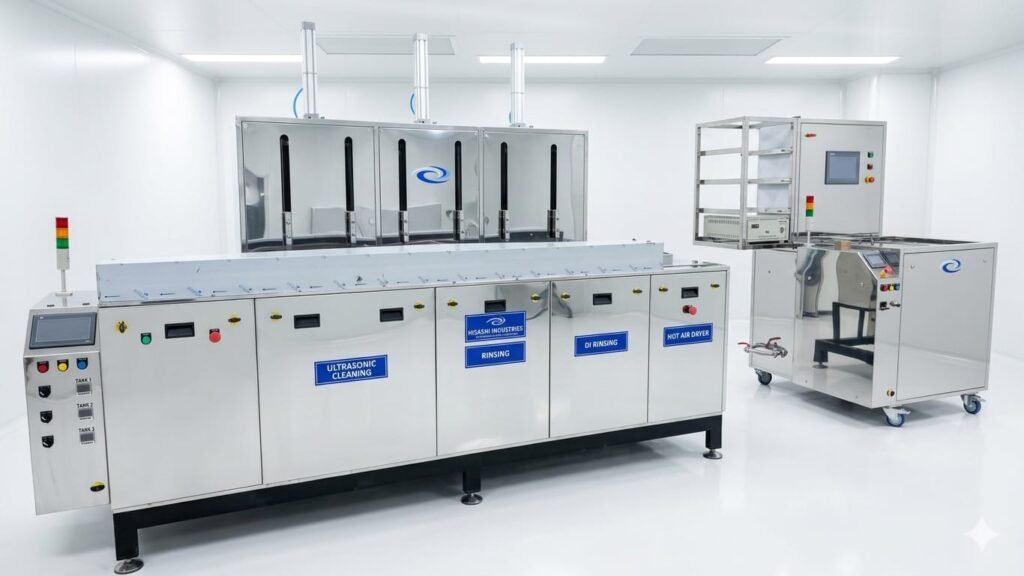
hisashiultrasonic designs and manufactures state-of-the-art customized multi tank ultrasonic cleaning plants in Noida. Our engineering team delivers tailormade multi-stage cleaning setups that eliminate manual labor, streamline industrial workflows, and safeguard delicate components.
While tabletop and single-tank ultrasonic cleaners handle small batch components effectively, high-volume production lines encounter structural bottlenecks with single-chamber setups:
Cross-Contamination Risk: Placing a heavy grease-laden part into a single wash tank leaves suspended oils behind. When the part lifts out, dirty fluid re-contaminates clean surfaces.
Chemical Drag-Out: Carrying raw cleaning chemistry directly to air drying or inspection stations degrades surface quality and leaves mineral white spots.
Incomplete Process Stages: Industrial parts cleaning requires a multi-step chemical sequence: pre-wash, ultrasonic degreasing, spray rinsing, rust inhibition, and forced hot-air moisture removal.
Throughput Bottlenecks: Manual immersion cycles limit daily part volume, leading to expensive factory downtime.
A customized multi tank ultrasonic cleaning plant solves these challenges by separating every process into dedicated stainless steel chambers. Components move systematically through ultrasonic washing, multi-stage cascading immersion rinsing, rust inhibition, and hot-air drying loops.
Ultrasonic cleaning relies on acoustic cavitation. Heavy-duty electronic generators send high-frequency electrical signals to piezoelectric transducers bonded onto the tank walls. These transducers expand and contract thousands of times per second, generating alternating high-pressure and low-pressure sound waves in the liquid solution.
Microscopic Bubble Formation: Low-pressure sound waves pull liquid apart, forming millions of microscopic vacuum cavities.
High-Energy Implosion: High-pressure phases cause these bubbles to collapse violently in microseconds.
High-Speed Fluid Micro-Jets: Implosions create localized fluid jets exceeding speeds of 400 km/h and localized temperatures near 5,000 K. These micro-jets scrub complex geometries, deep blind holes, and internal threads without scratching substrate surfaces.
In a multi-tank setup built by hisashiultrasonic, cavitation energy stays isolated within dedicated washing zones, keeping rinse stages pristine and free from floating sludge.
The engineering team at hisashiultrasonic customizes tank configurations based on metallurgy, part geometry, oil viscosity, and target cycle times. A typical industrial multi-stage plant features four to six functional modules:
Heavy oil, shop dirt, and loose chips undergo an initial wash. High-power low-frequency cavitation (28 kHz) breaks down thick petroleum grease, preventing heavy particulate from overloading secondary fine-cleaning tanks.
Fine oil films, polishing compounds, and microscopic particulate detach during this stage. hisashiultrasonic equips this tank with a weir tank oil skimmer and continuous filtration loops, stripping floating tramp oil into external decant chambers.
Submerged air-sparged spray nozzles and secondary ultrasonic agitation wash away residual alkaline chemistry. A counter-current cascading rinse system allows fresh water to enter from the final rinse tank and flow backward into earlier rinse chambers, minimizing water consumption.
Cast iron and carbon steel components oxidize quickly when exposed to air post-wash. A dedicated dip tank containing water-soluble corrosion inhibitors coats components with a protective rust-prevention layer before drying.
Insulated drying chambers equipped with high-velocity blowers, digital PID temperature controllers, and HEPA air filtration remove trapped moisture from deep blind holes, preventing water spots.
Selecting off-the-shelf equipment often leads to compromised performance, improper tank sizing, or early chemical corrosion. Custom engineering ensures every tank volume, heating capacity, and basket dimensions match your facility’s exact requirements.
| System Specification | Standard Off-the-Shelf Unit | Customized hisashiultrasonic Plant |
| Tank Material Grade | Standard 304 Stainless Steel | Heavy-gauge 316L Stainless Steel (Cavitation Resistant) |
| Ultrasonic Generator | Fixed-frequency manual generator | Digital Auto-Sweep Tracking Generator |
| Material Handling | Manual basket dipping by operators | Pneumatic or PLC Automatic Overhead Hoist |
| Filtration Capability | None or basic mesh strainer | Multi-stage Micron Cartridge Filters + Oil Skimmers |
| Process Control Interface | Analog switches or simple timers | Touchscreen HMI with PLC Recipe Storage |
| Local Service & Customization | Imported parts with long lead times | Direct Noida Factory Design, Assembly, & Field Support |
To maintain consistent cavitation efficiency and extend machine lifespan, follow this preventive maintenance routine:
Daily Skimmer & Strainer Cleanout: Remove trapped tramp oils from external decant tanks and clean gross particulate strainers.
Weekly Filter Cartridge Inspection: Inspect inline pressure gauges. Replace 5-micron filter cartridges when differential pressure rises, maintaining flow rates.
Monthly Tank Bottom De-Sludging: Drain wash tanks and wipe down internal walls. Accumulated metal sludge on the tank floor absorbs ultrasonic energy and accelerates transducer erosion.
Quarterly Transducer & Generator Audits: Perform foil erosion tests or measure acoustic power density using digital cavitation meters to ensure uniform acoustic output across all chambers.
Upgrading your factory’s cleaning infrastructure to a customized multi tank ultrasonic cleaning plant eliminates cleaning bottlenecks, lowers labor overhead, and ensures consistent quality. With tailored tank dimensions, automated hoist material handling, advanced digital generators, and robust filtration systems, hisashiultrasonic provides complete cleaning setups built for demanding industrial environments.
Transform your cleaning process with a system designed for your exact production specifications.