
Noida and Greater Noida have evolved into North India’s premier hubs for automotive manufacturing, electronics assembly, medical device production, and heavy precision engineering. As manufacturing tolerances shrink and quality standards rise, conventional manual scrubbing, high-pressure hose rinsing, and solvent dipping no longer meet modern industrial standards. Grease, carbon residues, fine metal shavings, flux, and microscopic oils trapped inside intricate geometries can cause component failure, coating defects, or costly operational downtime.
This quality demand has made precision industrial cleaning a core manufacturing stage rather than an afterthought. Industrial facilities require machinery that cleans rapidly, operates reliably, reduces chemical waste, and delivers repeatable cleanliness down to the micron level.
As a leading industrial cleaning machine manufacturer in Noida, hisashiultrasonic provides custom-engineered cleaning systems built specifically for Indian industrial requirements and global exports. In this comprehensive guide, we explore the science behind ultrasonic energy, examine the full spectrum of industrial cleaning machines available on the market, analyze key application sectors across Noida, and explain why partnering with hisashiultrasonic transforms your production line efficiency.
Before exploring specific machine designs, plant managers and quality engineers must understand the physical mechanism driving high-performance cleaning: acoustic cavitation.
┌────────────────────────────────────────────────────────────────────────┐
│                   THE ACOUSTIC CAVITATION PROCESS                      │
├────────────────────────────────────────────────────────────────────────┤
│ 1. High-Frequency Electrical Energy (20 kHz - 130 kHz)                 │
│    └─ Generated by state-of-the-art ultrasonic power supply            │
│                                                                        │
│ 2. Piezoelectric Transducers                                           │
│    └─ Convert electrical signals into mechanical sound vibrations      │
│                                                                        │
│ 3. Alternating High/Low Pressure Waves in Liquid Media                 │
│    └─ Form millions of microscopic vacuum bubbles during low pressure  │
│                                                                        │
│ 4. Rapid Cavitational Implosion                                        │
│    └─ Bubbles collapse inward, generating 5,000 K heat & localized    │
│       shockwaves that blast away contaminants instantly                │
└────────────────────────────────────────────────────────────────────────┘
When high-frequency sound waves travel through an aqueous or solvent medium, they create alternating compression (high-pressure) and rarefaction (low-pressure) cycles. During the low-pressure phase, high-intensity sound waves create millions of microscopic vacuum cavities (bubbles) in the fluid.
As these bubbles grow to a critical size, they can no longer absorb energy. During the subsequent high-pressure cycle, they violently implode. This implosion process—known as cavitation—generates localized fluid jets reaching speeds over 400 km/h and temperatures approaching 5,000 Kelvin at a microscopic scale.
Because these micro-explosions occur everywhere the liquid penetrates, cavitation dislodges stubborn soils from blind holes, internal threads, narrow channels, and porous surfaces that brushes or spray nozzles cannot reach.
Every manufacturing operation handles distinct components, production volumes, and contamination types. To serve diverse needs across Noida’s industrial sectors, hisashiultrasonic engineers and builds an array of cleaning machine configurations.
                          ┌───────────────────────────┐
                          │ INDUSTRIAL CLEANING RANGE │
                          └─────────────┬─────────────┘
                                        │
     ┌──────────────────┬───────────────┼───────────────┬──────────────────┐
     ▼                  ▼               ▼               ▼                  ▼
┌─────────┐       ┌───────────┐   ┌───────────┐   ┌───────────┐   ┌─────────────────┐
│ Single- │       │ Multi-    │   │ Vapour    │   │ Immersible│   │ Custom & PLC    │
│ Tank    │       │ Stage     │   │ Degreaser │   │ Transducer│   │ Automated       │
└─────────┘ └───────────┘ └───────────┘ └───────────┘ └─────────────────┘Single-tank units serve as the workhorse for small-to-medium workshops, toolrooms, and batch-cleaning operations. These compact, self-contained machines combine an ultrasonic generator, stainless steel tank, and built-in heating elements within a single footprint.
Key Features: Digital temperature controllers, timer modules, sweep-frequency modes, and heavy-duty stainless steel baskets.
Best Uses: Tooling maintenance, small engine parts washing, maintenance repair and overhaul (MRO) facilities, and laboratory equipment cleaning.
Why Choose hisashiultrasonic Single-Tanks: We build our single-tank shells using thick SS304 or SS316L stainless steel, ensuring maximum erosion resistance against prolonged cavitation.
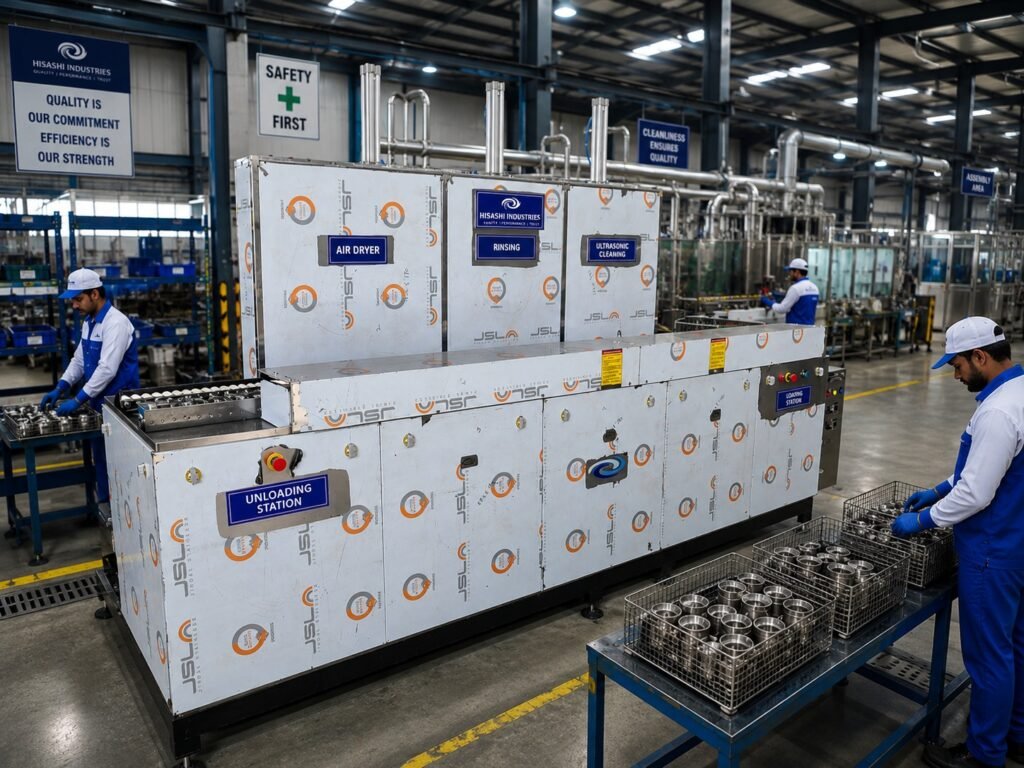
When high-precision components require washing, rinsing, passivating, and drying in a continuous production sequence, single-tank cleaning is insufficient. hisashiultrasonic designs multi-tank systems that walk parts through every critical cleanliness stage.
A standard 4-Stage hisashiultrasonic system operates across dedicated stations:
| Stage | Process Phase | Operational Function |
| Stage 1 | Ultrasonic Degreasing | High-power ultrasonic cavitation dislodges heavy oils, greases, and particulate soils. |
| Stage 2 | Immersion / Jet Rinsing | Agitated water rinses chemical residues and loose particles off workpiece surfaces. |
| Stage 3 | DI Water Fine Rinsing | Deionized water wash prevents mineral spot formation during final drying. |
| Stage 4 | Hot Air Recirculating Drying | High-velocity filtered hot air eliminates moisture instantly, preventing flash rusting. |
These systems frequently incorporate oil skimmers, continuous filtration pumps, and pneumatic basket lifters to maintain solution purity and eliminate manual lifting.
For manufacturers who already possess large steel washing tanks, hisashiultrasonic manufactures modular immersible transducer boxes. These hermetically sealed SS316L units mount directly into existing tanks—whether on the sides or bottom—instantly upgrading static soak tanks into high-efficiency ultrasonic cleaning stations.
Key Advantages: Cost-effective retrofitting, modular scalability, simple replacement, and custom dimensional sizing.
Common Applications: Large textile machinery cleaning, massive press die maintenance, and long pipe or tube degreasing baths.
In applications where water contact damages delicate electrical trace geometries or where organic oils require instant dissolution without aqueous drying cycles, solvent vapour degreasers excel.
hisashiultrasonic manufactures closed-loop vapour degreasers that boil non-flammable cleaning solvents inside a sealed chamber. Pure solvent vapour condenses onto cool metal components, dissolving greases and dripping away contaminants without leaving liquid residues. Our designs include sub-zero cooling coils that trap solvent vapors, minimizing fluid loss and keeping environmental emissions well within regulatory compliance limits.
Plastic injection molding, aluminum die-casting, and rubber compression processes leave tough burnt-carbon scale, gas marks, and polymer residues on expensive tooling dies. Manual scraping with wire brushes or abrasive pads ruins die dimensions, rounds off critical split lines, and reduces mold lifespans.
hisashiultrasonic manufactures specialized industrial mold cleaners that strip baked-on carbon, release agents, and rust without causing dimensional damage.
                     TRADITIONAL SCRAPING VS. ULTRASONIC DIE CLEANING

       Traditional Abrasive Method               hisashiultrasonic Cavitation
   ┌─────────────────────────────────┐       ┌─────────────────────────────────┐
   │ ✘ Scratches micro-polished dies │       │ ✔ Zero mechanical wear          │
   │ ✘ Damages sharp mold edges      │       │ ✔ Preserves tight tolerances    │
   │ ✘ Requires 4 to 8 hours labor   │       │ ✔ Cleans complete die in 30 min │
   │ ✘ Misses internal vent lines    │       │ ✔ Penetrates micro-vents        │
└─────────────────────────────────┘ └─────────────────────────────────┘Electronics assembly plants in Noida require delicate, high-frequency cleaning equipment to remove solder flux, paste residues, and atmospheric dust without destroying sensitive surface-mount components.
hisashiultrasonic builds specialized PCB cleaning machines operating at higher frequencies (typically 68 kHz to 130 kHz). Higher frequencies create smaller cavitation bubbles with lower implosion energy, providing gentle yet thorough cleaning action that preserves microscopic wire bonds and delicate semiconductor packages.
Selecting the proper machine configuration requires aligning equipment features with component specifications. The table below compares the technical parameters across the primary hisashiultrasonic machine classes:
| Machine Type | Ultrasonic Frequency | Tank Capacity | Primary Materials | Ideal Production Volume |
| Benchtop / Tabletop | 37 kHz – 40 kHz | 3 L – 30 L | SS304 / Plastic Trim | Low / Laboratory Batch |
| Single-Tank Industrial | 28 kHz – 40 kHz | 50 L – 500 L | Heavy SS304 / SS316L | Medium Batch / MRO |
| Multi-Stage Automated | Dual 28/40 kHz | 100 L – 2000+ L | SS316L Cavitation Tanks | High / Continuous Line |
| Vapour Degreaser | 40 kHz / Solvent Vapour | Custom Sizing | SS316L Sealed Chamber | High-Precision Electronics |
| Immersible Units | 25 kHz – 68 kHz | Custom Tank Fit | Sealed SS316L Enclosure |
Upgrading from traditional manual or solvent-based cleaning to an ultrasonic system from hisashiultrasonic yields substantial operational savings and environmental benefits:
                     TRADITIONAL CLEANING VS. HISASHI ULTRASONIC

       Traditional Manual Washing                hisashiultrasonic Systems
   ┌─────────────────────────────────┐       ┌─────────────────────────────────┐
   │ ✘ High solvent/chemical usage   │       │ ✔ Uses 80% less chemical volume │
   │ ✘ Intensive manual labor costs  │       │ ✔ Fully automated operation     │
   │ ✘ Inconsistent cleaning results │       │ ✔ 100% repeatable cleanliness   │
   │ ✘ Hazardous chemical exposure   │       │ ✔ Safe, eco-friendly operation  │
   └─────────────────────────────────┘       └─────────────────────────────────┘
Reduced Chemical Consumption: Ultrasonic cavitation amplifies the mechanical cleaning action of aqueous media, allowing factories to replace harsh, toxic solvents with mild, biodegradable alkaline chemistries diluted at lower concentrations.
Lower Labor Costs & Fast ROI: Manual cleaning requires dedicated operators scrubbing parts individually. A multi-stage system cleans large batches of parts simultaneously in minutes, allowing operators to focus on higher-value manufacturing tasks.
Minimized Component Damage & Scrap Rates: Brushes, scrapers, and high-pressure jet sprays can scratch or distort delicate precision components. Ultrasonic cavitation cleans without mechanical abrasion, protecting critical tolerances and lowering factory scrap rates.
Energy-Efficient Operation: Modern digital generators from hisashiultrasonic optimize power factor efficiency, reducing electrical draw while delivering consistent cleaning energy.
Achieving microscopic cleanliness is essential for maintaining product quality, operational reliability, and client satisfaction. As a premier industrial cleaning machine manufacturer in Noida, hisashiultrasonic combines local manufacturing expertise with cutting-edge ultrasonic technology to deliver systems tailored to your production demands.
Whether you need a compact tabletop cleaner for a testing lab, a heavy-duty single-tank degreaser, or an automated multi-stage washing plant, hisashiultrasonic engineers durable, eco-friendly, and cost-effective machinery built to perform for years.