
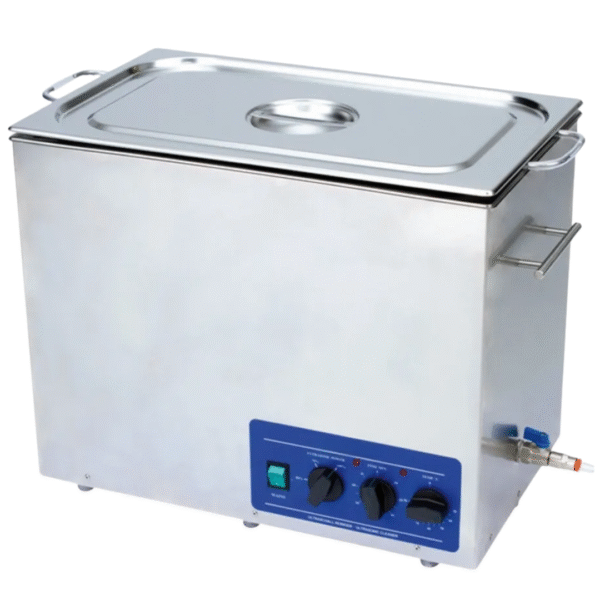
An ultrasonic cleaner for automotive workshops uses high-frequency sound waves (typically 28–40 kHz) to create microscopic bubbles in a cleaning solution. These bubbles collapse against metal surfaces — a process called cavitation — and physically lift away grease, carbon, rust, and brake dust from parts like carburetors, injectors, and brake components. For most workshops, a 20–40 liter ultrasonic tank with a heater and timer is the sweet spot for cleaning small to mid-sized auto parts in 10–20 minutes, without the scrubbing, solvents, or labor hours that manual cleaning demands.
If you run or work in an automotive workshop, you already know the pain: carbon-caked fuel injectors, gummed-up carburetors, and brake parts coated in years of grime. Traditional methods — wire brushes, degreaser dips, compressed air — eat up labor hours and rarely clean the tiny internal passages where buildup actually causes performance problems.
Ultrasonic cleaning solves this differently. Instead of scrubbing the outside, sound waves agitate the cleaning fluid itself, sending it into every groove, thread, and internal channel. That’s why fuel injector specialists and engine rebuild shops have used the technology for decades — it’s the only practical way to clean inside a component without disassembling it further.
For workshop owners, the appeal is simple: less manual labor, more consistent results, and parts that get genuinely clean rather than just surface-wiped.
An ultrasonic cleaner is a tank fitted with transducers that convert electrical energy into high-frequency vibrations. These vibrations pass through a liquid (usually water mixed with a cleaning solution) and generate millions of tiny vacuum bubbles every second.
When those bubbles implode near a dirty surface, they release a tiny burst of energy — strong enough to dislodge contaminants, gentle enough not to damage most metals, plastics, or delicate components.
Core components of an ultrasonic cleaner:
Part Type | Why Ultrasonic Cleaning Works Well |
Fuel injectors | Clears internal carbon deposits without disassembly |
Carburetors | Reaches tiny jets and passages manual cleaning misses |
Brake calipers & pads | Removes brake dust and corrosion from tight recesses |
Engine valves | Cleans carbon buildup from intricate shapes |
Alloy wheels | Lifts brake dust and road grime from spokes and crevices |
Small engine parts | Cleans bearings, gears, and fasteners uniformly |
Not every workshop needs the same machine. Here’s what actually matters when buying one.
Match the tank to your typical workload, not your biggest job:
Many commercial units offer dual-frequency or adjustable settings, which gives flexibility across different job types.
Warm solution (typically 50–65°C) dramatically improves cleaning speed and effectiveness on oil and grease. A built-in heater is non-negotiable for serious workshop use.
Look for stainless steel tanks (SUS304 or better) that resist corrosion from automotive-grade degreasers and solvents over years of daily use.
Workshops run machines for hours daily. Check the duty cycle rating — cheaper units built for jewelry or lab use often aren’t designed for continuous industrial-grade operation.
Expert tip: Replace cleaning solution regularly. A saturated solution redeposits contaminants onto parts instead of removing them — one of the most common reasons workshops think their machine “stopped working” when it’s actually the fluid.
Factor | Manual Cleaning | Ultrasonic Cleaning |
Labor time | High | Low to moderate |
Reaches internal passages | No | Yes |
Consistency | Varies by technician | Highly consistent |
Risk of part damage | Higher (scrubbing, scraping) | Lower (non-abrasive) |
Upfront cost | Low | Moderate to high |
Long-term cost per part | Higher (labor) | Lower over time |
Not all ultrasonic cleaners are built for the daily grind of a real workshop. Here’s what sets Hisashi Industries apart for automotive professionals:
For workshops that depend on their equipment every single day, Hisashi Industries focuses on durability and consistency first — so your cleaning process doesn’t become the bottleneck in your service bay.
An ultrasonic cleaner isn’t just a convenience for automotive workshops — it’s a practical upgrade that saves labor hours, improves cleaning consistency, and reaches places manual methods simply can’t. Whether you’re cleaning fuel injectors, carburetors, brake components, or small engine parts, choosing the right tank size, frequency, and build quality makes the difference between a machine that earns its keep and one that sits unused.
If you’re ready to bring reliable, industrial-grade ultrasonic cleaning into your workshop, Hisashi Industries can help you find the right fit for your daily workload and budget.
Contact us today for a personalized recommendation, or call now to discuss the best ultrasonic cleaner for your workshop’s specific needs.