
Every mold shop knows the moment: a precision injection mold comes off the line covered in carbon deposits, release agent residue, and hardened resin that’s crept into vents and cooling channels. The instinct is to grab a brass brush or a chemical soak and scrub it out. But molds are not simple metal blocks — they’re precision-engineered tools with tolerances measured in microns, and aggressive cleaning is one of the fastest ways to shorten their working life.
This is where an ultrasonic mold cleaning machine earns its place on the shop floor. Instead of scrubbing, scraping, or blasting, it uses sound waves traveling through a liquid to dislodge contamination, reaching into vents, ejector pin holes, and textured surfaces that are difficult or impossible to access safely with a brush or cloth.
Quick Answer: An ultrasonic mold cleaning machine submerges molds or mold components in a heated cleaning solution and applies high-frequency sound waves (typically 25–40 kHz). These waves create cavitation bubbles that collapse against the mold surface, lifting away carbon, resin, release agents, and rust. When frequency, power, chemistry, and exposure time are correctly matched to the mold material and contamination type, ultrasonic mold cleaning is a safe and effective method with minimal risk of surface damage to precision molds, vents, and fine surface textures.
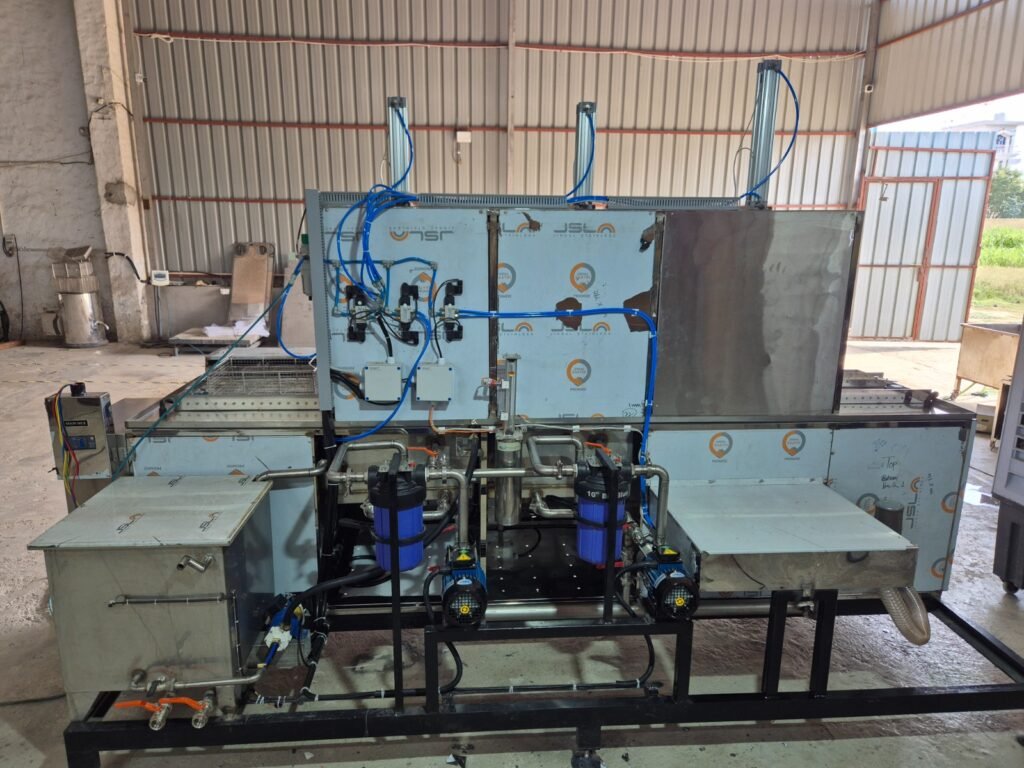
Most mold shops still rely on a mix of manual and mechanical cleaning methods. Each comes with a trade-off that ultrasonic mold cleaning is designed to reduce:
Ultrasonic mold cleaning avoids most of these trade-offs because the cleaning action happens through the liquid itself rather than through direct physical contact or abrasive pressure.
An ultrasonic mold cleaner works on a principle called cavitation. Transducers mounted in the tank convert electrical energy into high-frequency sound waves, which travel through the cleaning solution and create alternating zones of high and low pressure. In the low-pressure zones, microscopic vacuum bubbles form. When these bubbles reach a high-pressure zone, they collapse, releasing a small, localized burst of energy at the surface of the mold.
Across the full cleaning cycle, this collapsing-bubble action is capable of lifting baked-on carbon, oxidized rust, and cured resin off a metal surface. Whether it does so without affecting the base material depends on the frequency, power density, chemistry, and exposure time being appropriately matched to the mold’s hardness, plating, and surface finish — which is why machine setup and process parameters matter as much as the ultrasonic technology itself.
The main practical advantage of ultrasonic cleaning is reach: cavitation acts wherever the cleaning solution can circulate, including narrow vents, ejector pin bores, and undercuts that are largely inaccessible to a brush, pick, or spray nozzle. This is the core reason ultrasonic mold cleaning has become a standard part of precision mold maintenance in injection molding, die casting, and rubber compression molding operations.
Contamination Type | Common Source | Why It’s Hard to Remove Manually |
Carbon deposits / gas burn | Overheated resin, poor venting | Bakes hard onto cavity walls and vents |
Release agent residue | Silicone or wax-based mold release | Forms a film that clogs fine textures |
Cured resin / flash | Overflow into parting lines and vents | Lodges in undercuts brushes can’t reach |
Rust and oxidation | Storage in humid conditions | Spreads under textured or polished surfaces |
Cooling channel scale/sludge | Mineral deposits, coolant residue | Hard to access without disassembly |
Note: For sealed or blocked cooling channels, cleaning effectiveness depends on whether the solution can actually circulate through the passage. Severely restricted or fully blocked channels may need to be opened, flushed, or partially disassembled first — ultrasonic cleaning works best on channels that still allow solution flow.
The concern every toolroom manager raises before adopting ultrasonic cleaning is understandable: will the process affect dimensional accuracy or surface finish? In practice, ultrasonic mold cleaning is considered a low-risk process for hardened tool steel, chrome, and nickel-plated cavities when the process is correctly configured. Several factors determine that outcome:
In short, ultrasonic cleaning is not inherently risk-free on every mold under every setting — it becomes a low-risk, effective process when frequency, power, chemistry, and time are matched to the specific mold. This is also why the same underlying technology is used on more delicate precision components, such as optical lenses and surgical instruments, when parameters are set appropriately for those materials.
Frequency selection has a direct, practical effect on cleaning results, and getting it wrong is one of the more common mistakes in mold cleaning setup:
In practice, many mold shops benefit from a machine with adjustable or multi-frequency capability, so the same tank can handle both heavily fouled production molds and more delicate inserts without switching equipment.
While any mold shop can benefit, the impact is most visible in operations where mold precision directly affects part quality and downtime cost is high:
An ultrasonic mold cleaner is not a one-size-fits-all purchase. At Hisashi Industries, machine recommendations are built around the specifics of what a shop actually needs to clean — not a standard catalog size. The main factors we work through with a customer include:
These factors are worked through together rather than in isolation, since frequency, tank size, and heating all interact with each other once a mold’s actual dimensions, weight, and contamination profile are known.
Is ultrasonic mold cleaning safe for chrome-plated and textured molds?
It’s generally low-risk, but not automatically so under every setting. When frequency, power density, and cleaning chemistry are matched to the plating and texture, chrome plating, EDM textures, and polished finishes are not expected to show meaningful surface effects. Incorrect settings — particularly excessive power or exposure time — can increase risk, which is why process setup matters.
How long does an ultrasonic mold cleaning cycle take?
Most cycles run between 10 and 30 minutes depending on the level of contamination, mold size, and solution temperature.
Can ultrasonic mold cleaning remove rust from stored molds?
Yes, ultrasonic cleaning combined with a suitable rust-removal solution can lift surface oxidation, though heavily corroded areas may need a follow-up pass or manual touch-up.
Can ultrasonic cleaning reach cooling channels?
It can, but effectiveness depends on whether the cleaning solution can actually circulate through the channel. Open or lightly restricted channels generally respond well; severely blocked or fully sealed channels may need flushing or partial disassembly before ultrasonic cleaning can be effective.
Does ultrasonic mold cleaning replace the need for mold release and maintenance oils?
No. Ultrasonic cleaning removes contamination before the mold goes back into service; anti-rust coatings and release agents are still applied afterward as part of normal mold maintenance.
What size ultrasonic mold cleaning machine does a mold shop typically need?
This depends on the largest mold or mold component handled regularly, its weight, and the typical contamination type. Shops working with small precision inserts may need only a compact tank, while shops cleaning full mold bases require larger industrial units with heavier-duty baskets.
Hisashi Industries designs and manufactures industrial ultrasonic cleaning equipment for precision mold maintenance. Rather than offering a single standard configuration, we recommend and customize tank size, frequency, heating, and filtration based on your mold dimensions, weight, contamination type, and required cleaning process — whether that’s an injection mold cleaning machine for routine production molds or a precision mold cleaning setup for fine, delicate tooling.
📞 +91 9871013815 | ✉️info@hisashiindustries.com | 🌐 hisashiultrasonic.com