
An industrial ultrasonic cleaner manufacturer designs cleaning systems that use high-frequency sound waves and cavitation to remove oil, grease, carbon deposits, rust, and particulate contamination from components. The right manufacturer builds machines around your component geometry, contamination type, and production volume — not a one-size-fits-all tank — and offers single-stage, multi-stage, and fully customized configurations for automotive, medical, electronics, and general engineering applications.
If you manufacture or maintain precision components, you already know that not every cleaning problem responds to the same solution. A gearbox housing coated in machining oil, a surgical instrument that needs validated residue-free cleanliness, and a PCB with flux residue in narrow gaps all demand different approaches — even though all three can be solved with ultrasonic cleaning technology.
This is where working with an experienced industrial ultrasonic cleaner manufacturer makes a measurable difference. A manufacturer who understands cavitation physics, filtration, material compatibility, and industry-specific contamination can help you avoid the two most common mistakes buyers make: choosing a machine based on price alone, or choosing a generic tank that isn’t built for the actual part.
This guide walks through how ultrasonic cleaning works, what to evaluate before you buy, why customization matters more than most buyers expect, and where this technology is applied across industry.
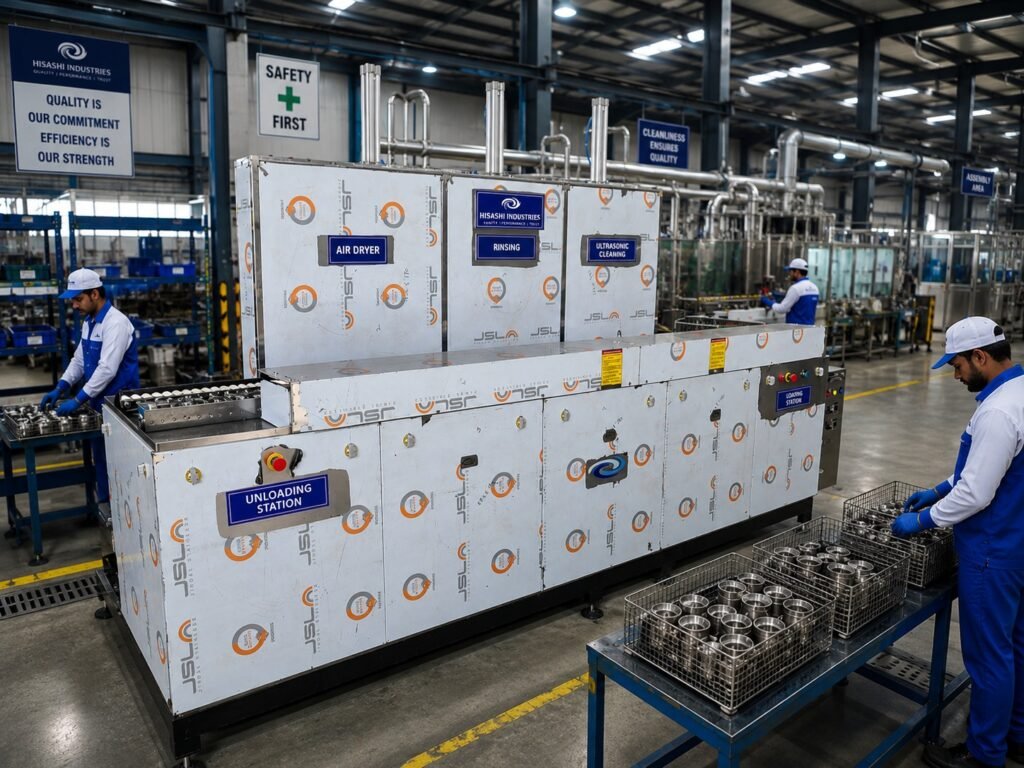
Ultrasonic cleaning relies on a phenomenon called cavitation. A generator sends high-frequency electrical energy to transducers mounted on or immersed in a cleaning tank. The transducers convert this energy into sound waves that travel through the cleaning solution, typically in the 25–80 kHz range depending on the application.
These sound waves create millions of microscopic vacuum bubbles in the liquid. As the bubbles collapse — a process that happens in microseconds — they release concentrated bursts of energy directly onto the surface of the component being cleaned. This implosive action reaches into blind holes, threads, crevices, and complex internal geometries that brushes, sprays, or manual wiping simply cannot access.
The result is contact-free, mechanically consistent cleaning that works equally well on delicate precision parts and heavily contaminated industrial components, provided the frequency, solution chemistry, and cycle time are matched correctly to the part.
Selecting an ultrasonic cleaning machine is not just about tank size. Several interdependent factors determine whether a system will actually perform well on your components over years of production use.
Factor | Why It Matters |
Tank Capacity | Must accommodate current part sizes and batch volumes, with room for planned production growth. |
Ultrasonic Frequency | Lower frequencies (25–40 kHz) suit heavy, rugged parts; higher frequencies (60–80 kHz) suit delicate, precision, or medical components. |
Automation Level | Manual, semi-automatic, or fully automatic multi-stage lines depend on labor availability and production throughput targets. |
Filtration System | Continuous filtration extends bath life, maintains consistent cleaning quality, and reduces chemical consumption. |
Heating | Many cleaning chemistries perform significantly better within a specific temperature range; heated tanks improve degreasing efficiency. |
Component Size & Geometry | Basket design, fixturing, and tank dimensions must match part shape to ensure uniform ultrasonic exposure. |
Contamination Type | Oil, carbon, rust, and biological residues each respond differently to frequency and chemistry choices. |
Production Volume | Batch cleaning suits lower volumes; multi-stage conveyorized or IoT-enabled systems suit continuous high-volume lines. |
Material Compatibility | Aluminium, brass, stainless steel, and plastics each have different sensitivities to cavitation intensity and chemical exposure. |
A common mistake is selecting equipment purely on quoted price. Two machines that look similar on paper can perform very differently once frequency mismatch, inadequate filtration, or poor fixturing come into play on the actual production floor. The more reliable approach is to start from your component and contamination profile, then work backward to the right specification — which is why sharing sample parts or detailed component data with the manufacturer before purchase is worth the extra step.
Standard, off-the-shelf ultrasonic tanks work reasonably well for simple, uniform parts. But most industrial components are not simple or uniform — they have internal channels, blind holes, mixed materials, or tight cleanliness tolerances that a generic tank was never designed around.
A customized system addresses this by tailoring several elements to the actual application:
For example, a surgical instrument cleaning line has very different requirements from an automotive engine component line. The former prioritizes validated cleanliness and gentle handling of delicate instruments; the latter prioritizes heavy degreasing throughput and durability under continuous industrial use. Treating both as the same “ultrasonic tank” problem produces a system that underperforms in at least one direction.
Ultrasonic cleaning is widely used for engine parts, fuel system components, gearbox parts, and other components that accumulate oil, grease, and carbon deposits during machining and use. An automotive ultrasonic cleaner configured for this segment typically emphasizes degreasing strength and durability for continuous shop-floor operation.
Medical cleaning demands precise, repeatable results with gentle handling of delicate instrument geometries. A medical ultrasonic cleaner is generally built around higher-frequency cavitation and careful material compatibility to avoid surface damage while still achieving thorough residue removal.
PCBs and precision electronic assemblies require careful removal of flux and particulate residue without damaging sensitive components. PCB cleaning machines typically use controlled frequency and chemistry to protect delicate solder joints while still reaching into narrow gaps between components.
Dies, molds, gas valves, anilox rollers, and general engineering components often accumulate rust, scale, or process residues that are difficult to remove manually. Purpose-built systems such as an ultrasonic mold cleaning machine or a gas valve cleaning machine are designed around the specific geometry and contamination these components present.
Hisashi Industries has been operating since 2008 and manufactures a broad range of ultrasonic cleaning equipment, including ultrasonic cleaners, single-stage industrial systems, multi-stage aqueous cleaning systems, and immersible transducer boxes for retrofitting existing tanks.
The company builds machines around the customer’s component and production requirement rather than offering a single standard configuration, and it works across automotive, medical, electronics, and general engineering segments. For businesses evaluating a cleaning system, this means the conversation typically starts with the part — its material, contamination, and cleanliness target — rather than a fixed catalog spec sheet.
If you’re comparing manufacturers, it’s worth asking any prospective supplier — Hisashi included — for a trial run on your actual components before committing. A manufacturer confident in their equipment’s performance on your specific parts should be willing to demonstrate it.
A single-stage system performs cleaning in one tank and is suited to simpler contamination or lower production volumes. A multi-stage system moves components through sequential wash, rinse, and dry stages, which is typically necessary when higher cleanliness levels or higher throughput are required.
It depends on the part. Lower frequencies (around 25–40 kHz) generate stronger cavitation suited to heavy, rugged components, while higher frequencies (60 kHz and above) produce gentler cavitation suited to delicate or precision parts such as medical instruments and electronics.
When frequency, cycle time, and chemistry are matched correctly to the component’s material, ultrasonic cleaning is non-abrasive and safe for most metals and many plastics. Mismatched settings — particularly excessive cavitation intensity on soft or delicate materials — are the main cause of surface damage, which is why proper machine specification matters.
For most industrial applications, yes. Continuous filtration removes displaced contaminants from the bath, which maintains cleaning consistency over multiple cycles and extends the usable life of the cleaning solution.
If your components have complex geometries, mixed materials, tight cleanliness tolerances, or high production volumes, a standard tank often can’t deliver consistent results. Sharing your component details or sample parts with a manufacturer is the most reliable way to determine whether a custom configuration is needed.
Automotive manufacturing, medical and surgical instrument processing, electronics and PCB assembly, and general engineering and tooling operations are among the most common users of industrial ultrasonic cleaning systems.
Price is one factor, but not the most important one. A machine that’s mismatched to your component’s frequency, filtration, or automation needs can cost more in rework, inconsistent results, or premature wear than the initial savings on a cheaper unit.
Every component and contamination challenge is different. The most reliable next step is to share your part details, drawings, or a sample with our team so we can recommend the right frequency, tank configuration, filtration, and automation level for your actual production requirement — not a generic off-the-shelf spec.
Ready to solve your cleaning challenge?
Request a Cleaning Trial Send Component Details Discuss Your Requirement
Call +91 9871013815 | Email info@hisashiindustries.com