
Picture this: a batch of precision CNC components comes off the machining line covered in oil, metal fines, and stubborn coolant residue. Someone hands them over for manual cleaning with a brush and a bucket of solvent. Two hours later, half the parts still have grime stuck in the tiny grooves and threads that hands and brushes simply can’t reach. Sound familiar?
This is exactly the problem that pushes most workshop owners, PCB manufacturers, and equipment distributors to start searching for a reliable way to Buy an Industrial Ultrasonic Cleaner. But the moment you start looking, you’re hit with dozens of specifications, tank sizes, frequencies, and suppliers making big promises. It gets confusing fast.
This guide breaks it all down in plain language, so whether you run an automotive workshop, a CNC job shop, or an electronics assembly line, you’ll know exactly what to look for before you spend your money on an ultrasonic cleaner.
At its core, an industrial ultrasonic cleaner is a tank filled with a cleaning solution (usually water-based) that uses high-frequency sound waves to create millions of tiny bubbles. These bubbles form and collapse in a process called cavitation. When a bubble collapses near a dirty surface, it releases a tiny burst of energy that literally scrubs away oil, grease, carbon deposits, rust, flux residue, and other contaminants — even from areas a brush could never reach, like blind holes, internal threads, and fine mesh.
Unlike manual cleaning, ultrasonic cleaning doesn’t rely on scrubbing pressure or harsh chemicals to get the job done. It relies on physics. That’s why it’s become the standard cleaning method across automotive workshops, CNC machining units, PCB manufacturing lines, mold and die shops, and jewelry and precision instrument cleaning setups.
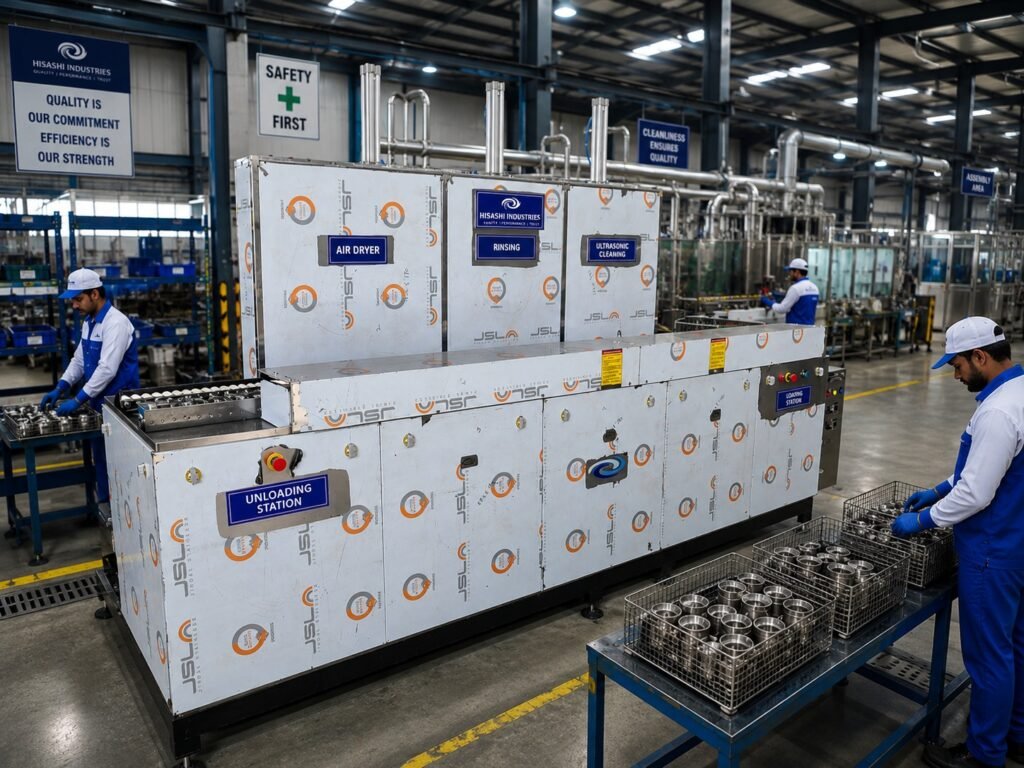
Manual cleaning methods are slow, inconsistent, and often unsafe when solvents are involved. An Ultrasonic Cleaner solves all three problems at once — it’s faster, it cleans every part the same way every time, and most industrial units are designed to work safely with water-based or mild cleaning agents instead of harsh chemicals.
Not every ultrasonic cleaner is built for the same job. The tank size, frequency, and heating capacity should match what you’re actually cleaning. Here’s a quick breakdown to help you compare options before you buy.
Industry / Use Case | Typical Frequency | Common Tank Size | Best Suited For |
Automotive Workshops | 28–40 kHz | 30–100 litres | Carburetors, injectors, engine parts, brake components |
CNC Machining Shops | 25–40 kHz | 50–250 litres | Machined metal parts, coolant and oil residue removal |
PCB Manufacturing | 40–80 kHz | 10–50 litres | Flux residue, solder paste, board degreasing |
Mold & Die Cleaning | 25–28 kHz | 100–500 litres | Heavy carbon and resin buildup on molds |
Jewelry & Precision Items | 40–120 kHz | 2–20 litres | Fine detailing without surface damage |
This is where most first-time buyers get overwhelmed. You don’t need to become an engineer overnight, but knowing these few things will save you from buying the wrong machine.
Feature to Check | Why It Matters |
Tank Capacity | Determines how many parts or batches you can clean at once — undersized tanks slow down production |
Frequency (kHz) | Lower frequencies suit heavy-duty degreasing; higher frequencies suit delicate, fine cleaning |
Heating Function | Heated solutions clean oils and grease far more effectively than cold water |
Timer & Digital Controls | Lets you set consistent cleaning cycles without manual monitoring |
Build Material (SS 304/316) | Determines durability and resistance to corrosion from cleaning chemicals |
Transducer Quality | Affects cavitation strength, cleaning speed, and machine lifespan |
After-Sales Support | Industrial machines need servicing — a supplier without local support can cost you downtime |
Buying industrial equipment shouldn’t feel like guesswork. Here’s a simple process to follow.
Step | What to Do |
Step 1 | List the exact parts or products you need to clean, including size and material |
Step 2 | Identify the contamination type — oil, flux, carbon, dust, or polishing compounds |
Step 3 | Estimate your daily or weekly cleaning volume to decide on tank size |
Step 4 | Shortlist manufacturers with proven industrial experience, not just importers |
Step 5 | Ask for a live demo or trial run with your actual components if possible |
Step 6 | Check warranty terms, spare part availability, and service response time |
Step 7 | Finalize the purchase and plan for operator training on usage and maintenance |
A lot of buyers make the same avoidable mistakes — here’s what to watch out for.
Checklist Item | Confirmed? |
Cleaning requirement clearly identified | Yes / No |
Correct tank size and frequency shortlisted | Yes / No |
Manufacturer credibility verified | Yes / No |
Warranty and service terms reviewed | Yes / No |
Demo or sample cleaning trial completed | Yes / No |
Budget compared against long-term value, not just upfront cost | Yes / No |
Prices vary widely based on tank size, frequency, and features like heating and digital timers. Small bench-top units cost far less than large industrial systems with multi-stage tanks, so it’s best to get a quote based on your specific requirement.
No, when used correctly. Ultrasonic cleaning is actually gentler than manual scrubbing since it doesn’t involve physical contact. The key is choosing the right frequency — higher frequencies are safer for delicate or precision components.
Most cycles range from 5 to 20 minutes, depending on the contamination level and part complexity. Heavily soiled parts with baked-on grease may need longer or repeated cycles.
If you’re cleaning oil, grease, or wax residues, yes — heating significantly improves cleaning speed and results. For light dust or polishing residue, an unheated unit may be sufficient.
Industrial units are built for continuous, heavy-duty use with sturdier tanks, stronger transducers, and larger capacities, while commercial or bench-top units are meant for lighter, occasional use.
Routine maintenance like tank cleaning and solution replacement should be done regularly (often weekly, depending on usage), while transducer and generator checks are typically recommended every few months by the manufacturer.
Buying an industrial ultrasonic cleaner isn’t just about picking a machine off a catalog — it’s about matching the right tank size, frequency, and build quality to what your business actually needs to clean every single day. Get that match right, and you’ll cut cleaning time, improve part quality, and reduce manual labor dependency for years to come.
At Hisashi Industries, this is exactly the kind of guidance we walk our customers through before every purchase — whether it’s a compact unit for a small workshop or a fully automatic multi-tank system for a high-volume production line. If you’re ready to find the right ultrasonic cleaner for your application, our team is happy to help you figure out the specifications that actually make sense for your business, not just the ones that sound impressive on paper.
Hisashi Industries is a Greater Noida-based manufacturer and supplier of industrial ultrasonic cleaning equipment, trusted by automotive workshops, CNC machining shops, PCB manufacturers, electronics assemblers, and industrial equipment distributors across India. With a strong focus on build quality, performance, and after-sales support, we help businesses move away from slow, inconsistent manual cleaning and switch to reliable, efficient ultrasonic cleaning solutions built for real industrial use.
Have a cleaning challenge you’re not sure how to solve? Get in touch — we’re happy to help you find the right machine for your application.
Email Us: info@hisashiindustries.com
Call Us: +91 9871013815
Our Location: Greater Noida – 203207