
In modern manufacturing, precision cleaning is no longer just a maintenance process, it is directly connected to product quality, operational efficiency, and customer satisfaction. Industries today deal with increasingly complex components where even microscopic contamination can lead to coating failure, improper assembly, leakage issues, or rejection during inspection. Oil residue, polishing compounds, coolant deposits, carbon particles, and machining debris can remain trapped inside grooves, blind holes, and internal channels that traditional cleaning methods fail to reach effectively.
This is why manufacturers across automotive, aerospace, electronics, medical devices, and precision engineering industries are upgrading to advanced ultrasonic cleaning systems. Hisashi Industries has been supporting this transition by providing industrial ultrasonic degreasing solutions designed around real production challenges rather than generic cleaning requirements.
As an experienced Industrial Ultrasonic Degreasing Machine manufacturer in India, the focus is not only on cleaning efficiency but also on process consistency, automation, customization, and long-term operational reliability.
Industrial components go through multiple manufacturing stages such as CNC machining, grinding, stamping, polishing, welding, and fabrication. During these processes, contaminants build up on component surfaces and internal cavities.
In many factories, manual washing or solvent cleaning still remains common. However, manufacturers often face recurring problems such as:
For precision industries, these issues directly affect production cost and customer confidence.
An Industrial Ultrasonic Degreasing Machine solves these problems through deep, controlled, and repeatable cleaning.
An ultrasonic cleaning system uses high-frequency sound waves transmitted through a cleaning liquid. These sound waves generate microscopic cavitation bubbles that rapidly collapse near the surface of components.
This cavitation process removes:
Unlike manual cleaning methods, ultrasonic cleaning reaches intricate areas such as threads, blind holes, grooves, internal passages, and complex geometries without damaging the surface.
This makes ultrasonic cleaning particularly effective for high-precision industrial components.
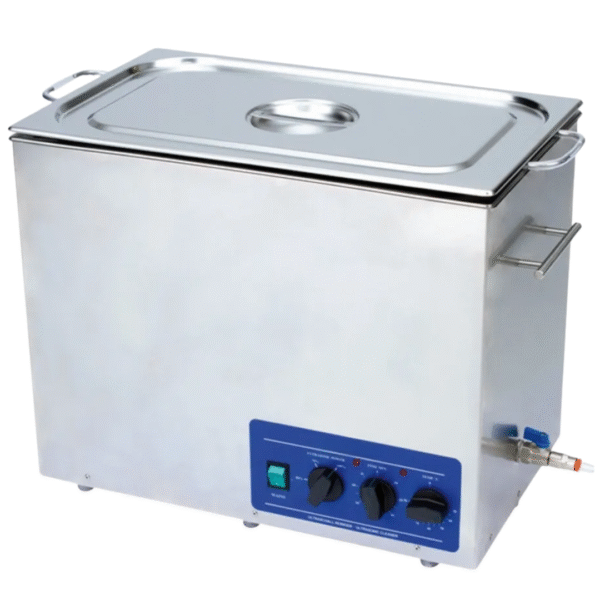
Many manufacturers shift to ultrasonic cleaning after facing repeated production and quality challenges.
For example, an automotive supplier cleaning fuel injection components may experience coating inconsistency due to residual oil trapped inside internal passages. Manual washing may clean visible surfaces but fail inside narrow cavities. A multistage ultrasonic degreasing system solves this issue by ensuring complete cleaning throughout the component.
Similarly, CNC machining units producing hydraulic blocks often struggle with fine metal chips remaining inside drilled passages. These particles can affect assembly performance later. Ultrasonic cleaning removes microscopic debris more effectively than air pressure or manual flushing.
Electronics manufacturers also use ultrasonic cleaning to remove solder flux and contamination from precision assemblies where delicate surfaces cannot tolerate aggressive cleaning methods.
These real-world applications show why ultrasonic cleaning has become an essential part of modern industrial manufacturing.
Single-stage cleaning systems often leave contaminants suspended in the same cleaning tank, increasing the possibility of cross-contamination. This is why advanced manufacturers prefer multistage ultrasonic cleaning systems.
A modern Industrial Ultrasonic Degreasing Machine may include:
This sequential cleaning process improves consistency while reducing contamination transfer between stages.
Multistage systems also improve production efficiency by automating the complete cleaning cycle rather than depending on manual handling between tanks.
Ultrasonic frequency selection plays an important role in cleaning performance.
25kHz systems produce stronger cavitation and are generally preferred for:
This frequency provides aggressive cleaning action suitable for tough contaminants.
40kHz systems create finer cavitation bubbles and are ideal for:
This frequency offers gentler cleaning while still achieving deep contaminant removal.
Manufacturers often choose the frequency based on component sensitivity, contamination type, and required cleaning intensity.
Modern industries require more than basic cleaning equipment. Today’s ultrasonic systems are designed for process control, repeatability, and automation.
PLC automation ensures every cleaning cycle follows preset parameters for time, temperature, and process sequence. This improves consistency across production batches.
Advanced systems may include IoT-enabled ultrasonic generators that allow real-time monitoring, maintenance tracking, and operational diagnostics.
Controlled heating improves chemical performance and enhances cleaning efficiency, especially for oil and grease removal.
Different industries require different cleaning approaches. Custom tank sizes, basket configurations, transfer mechanisms, and multistage layouts help align the cleaning system with production workflows.
Hot air drying systems reduce moisture retention and prepare parts directly for assembly or packaging.
As an Indian manufacturer of ultrasonic cleaning systems, Hisashi Industries focuses on practical industrial applications rather than standardized equipment alone.
Their systems are designed for:
The company also supports manufacturers through process understanding, system customization, and cleaning workflow optimization.
Manufacturers upgrading to advanced ultrasonic cleaning systems often experience:
For many industries, ultrasonic cleaning becomes a long-term operational advantage rather than just a cleaning process.
It is an industrial cleaning system that uses ultrasonic cavitation to remove oil, grease, and contaminants from industrial parts.
Automotive, aerospace, electronics, medical, CNC machining, and engineering industries commonly use ultrasonic cleaning systems.
They prevent cross-contamination and improve cleaning consistency through separate cleaning, rinsing, and drying stages.
25kHz provides stronger cleaning for heavy contaminants, while 40kHz is better for delicate precision components.
Yes, systems can be customized based on component type, contamination level, production volume, and automation requirements.
As manufacturing standards continue to rise, cleaning quality has become a critical part of production efficiency and product reliability. An Industrial Ultrasonic Degreasing Machine helps manufacturers achieve deeper cleaning, consistent results, and improved quality control while reducing labor dependency and rejection rates.
For industries facing contamination-related production issues, upgrading to advanced multistage ultrasonic cleaning systems can significantly improve operational performance and long-term manufacturing quality.
If your factory is dealing with inconsistent cleaning quality, coating failures, contamination issues, or rising rejection rates, it may be time to upgrade your cleaning process.
Contact Us at Hisashi Industries to explore precision cleaning solutions designed specifically for industrial manufacturing applications.
Their team can help you evaluate:
You can also discuss your component cleaning challenges or send sample parts for evaluation to identify the most effective ultrasonic cleaning solution for your application.