
Pharmaceutical manufacturing demands absolute cleanliness. In drug synthesis, tablet compression, or sterile liquid filling, even microgram-level cross-contamination compromises safety and breaches regulatory guidelines. Traditional manual scrubbing and spray washing often fail to reach microscopic crevices, blind holes, and complex mechanical geometries found in modern pharmaceutical tooling.
Manual cleaning consumes labor, risks operator fatigue, and introduces human error. Consequently, pharmaceutical facilities in Noida and across India rely on high-precision ultrasonic cleaning systems.
hisashiultrasonic stands at the forefront of this industrial transition. As a premier pharmaceutical ultrasonic cleaner manufacturer in Noida, hisashiultrasonic builds advanced, cGMP-compliant cleaning equipment designed specifically for pharmaceutical production lines, quality control laboratories, and R&D centers.
In this comprehensive guide, we explore how ultrasonic technology works, detail the different machine types manufactured by hisashiultrasonic, outline critical regulatory compliance parameters, and explain why Noida has become the preferred center for high-performance cleaning equipment.
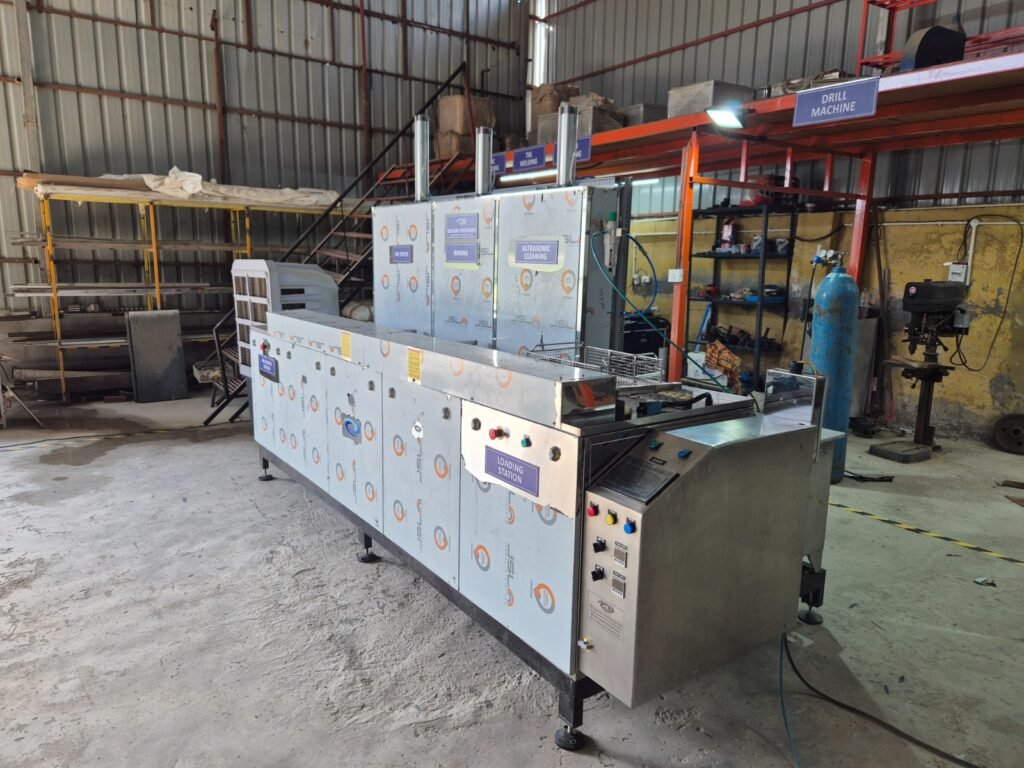
A pharmaceutical ultrasonic cleaner uses high-frequency sound waves—typically ranging from 28 kHz to 80 kHz—to remove contaminants from precision components. The core physical principle driving this process is acoustic cavitation.
+-----------------------------------------------------------------------+
|                         THE CAVITATION CYCLE                          |
|                                                                       |
|  [ Generator ] ---> High-Frequency Electrical Signals                 |
|                            |                                          |
|                            v                                          |
|  [ Transducer ] ---> Converts Electrical Signals to Mechanical Sound   |
|                            |                                          |
|                            v                                          |
|  [ Liquid Bath ] ---> Rapid Alternating Compression & Expansion Waves |
|                            |                                          |
|                            v                                          |
|  [ Cavitation ] ---> Microscopic Vacuum Bubbles Form and Grow         |
|                            |                                          |
|                            v                                          |
|  [ Implosion ]  ---> Micro-Jets Blast Away Foreign Contaminants       |
+-----------------------------------------------------------------------+Energy Conversion: High-efficiency piezoelectric transducers attached to the bottom or sides of a stainless steel tank convert electrical energy from an ultrasonic generator into high-frequency mechanical sound waves.
Bubble Formation: As sound waves travel through the liquid cleaning solution, they create alternating high-pressure (compression) and low-pressure (rarefaction) cycles. During low-pressure cycles, millions of microscopic vacuum bubbles form in the solution.
Violent Implosion: When these bubbles reach a critical size during high-pressure cycles, they collapse inward rapidly.
Scouring Action: Each implosion releases localized high temperatures (up to 5,000 K) and extreme pressure jets (up to 20,000 PSI) on a microscopic scale. These micro-jets lift oils, active pharmaceutical ingredients (APIs), excipients, carbon deposits, and biological soils off surfaces without scratching the underlying metal.
Pharmaceutical companies face strict audits from global health regulators such as the US FDA, WHO, and MHRA. Conventional cleaning methods present several operational liabilities that automated ultrasonic cleaners eliminate.
| Feature / Metric | Manual Hand Scrubbing | Conventional Spray Washing | hisashiultrasonic Systems |
| Cleaning Depth | Surface only; misses blind holes | External surfaces; weak in crevices | Deep, 360-degree microscopic penetration |
| Consistency | Operator-dependent; high variance | Moderate variance | 100% reproducible, automated cycles |
| Cleaning Duration | 45–90 minutes per batch | 20–40 minutes per batch | 5–15 minutes per batch |
| Water & Solvent Usage | High volume; significant waste | Moderate volume | Low volume; recycled via filtration |
| Risk of Tool Damage | High (scratching, wire brush wear) | Moderate | Zero abrasive wear; gentle on parts |
| Operator Safety | Direct exposure to hazardous solvents | Splashing risks | Enclosed, hands-free operation |
Understanding the distinct machine configurations helps pharmaceutical engineers select the ideal cleaner for their facility. hisashiultrasonic manufactures five main equipment classes tailored for pharmaceutical applications.
+-----------------------------------------------------------------------------------+
|                        hisashiultrasonic PRODUCT LINEUP                           |
|                                                                                   |
|  [ Benchtop / Lab Cleaners ] ---------> QC Labs, R&D, Glassware, Syringes          |
|  [ Single-Tank Industrial Cleaners ] -> Heavy Parts, Dosing Tools, Valves          |
|  [ Multi-Stage Automated Systems ] --> High-Volume Tablet Tooling & Packaging    |
|  [ Immersible Transducer Packs ] ----> Retrofitting Existing Wash Tanks           |
|  [ Custom cGMP Pass-Through Stations ]> Cleanroom Wall Integrations               |
+-----------------------------------------------------------------------------------+
Designed for analytical laboratories, quality control (QC) departments, and small-scale formulation units, these compact benchtop models deliver high-frequency precision in a small footprint.
Tank Capacity Range: 3 Liters to 30 Liters
Operating Frequency: 40 kHz or 80 kHz (high frequency for delicate items)
Key Features: Digital timer displays, heating control (up to 80°C), degas mode, sweep mode.
Primary Applications: Cleaning HPLC vials, volumetric flasks, test tubes, syringes, filter membranes, and dissolution test baskets.
Expert Engineering Note: The degas mode removes dissolved gases from fresh cleaning liquids, maximizing cavitation energy before the cleaning cycle starts.
Single-tank industrial units provide robust, high-power cleaning for larger mechanical components and tablet compression tools.
Tank Capacity Range: 50 Liters to 500+ Liters
Operating Frequency: 28 kHz (heavy soil removal) or 40 kHz (general precision cleaning)
Key Features: Heavy-gauge SS 316L tank construction, insulated outer walls, digital temperature controllers, overflow weirs, and oil skimmer loops.
Primary Applications: Cleaning tablet punches and dies, granulator screens, hopper feed frames, agitator blades, and pump housings.
For high-throughput pharmaceutical manufacturing plants, single-tank cleaning is often insufficient. hisashiultrasonic designs multi-stage automated lines that move components through sequential wash, rinse, and dry steps without manual handling.
+---------------------------------------------------------------------------------+
|                       MULTI-STAGE AUTOMATED PROCESS                             |
|                                                                                 |
|  [ Stage 1: Ultrasonic Wash ] ---> Detergent + 40 kHz Cavitation                |
|           |                                                                     |
|           v                                                                     |
|  [ Stage 2: DI Water Rinse ] ----> Removes Residual Detergent                   |
|           |                                                                     |
|           v                                                                     |
|  [ Stage 3: Ultra-Pure Rinse ] -> Final Pass with Hot DI Water                      |
|           |                                                                     |
|           v                                                                     |
|  [ Stage 4: HEPA Hot-Air Dryer ]> Dries Parts to Prevent Spotting / Oxidation   |
+---------------------------------------------------------------------------------+
System Design: 3 to 6 interconnected stainless steel tanks.
Automation: Overhead pneumatic or motorized robotic pick-and-place basket transfer mechanisms.
Key Features: Continuous closed-loop DI water filtration, conductivity monitoring, HEPA-filtered hot air drying chambers, and integrated touchscreens.
Primary Applications: Automated tablet punch cleaning, blister pack tooling, filling nozzles, and ampoule cleaning lines.
For pharmaceutical facilities that already possess custom stainless steel washing tanks or inline dipping channels, hisashiultrasonic supplies standalone immersible transducer boxes.
Installation Options: Bottom-mounted, side-wall mounted, or rack-hung configurations.
Construction: Hermetically sealed laser-welded SS 316L or Titanium casings.
Generator Drive: Matched with external digital ultrasonic generators featuring auto-tuning circuits.
Primary Applications: Retrofitting existing CIP/COP tanks, upgrading legacy washing units, or integrating into custom automated conveyors.
Designed specifically for cleanroom environments (Class 100 / ISO 5 through Class 10,000 / ISO 7), hisashiultrasonic constructs pass-through ultrasonic cleaning stations.
Design Concept: Wall-mounted units bridging gray space (uncontrolled area) and cleanroom space (classified area).
Interlocking Doors: Double-door system prevents air exchange between rooms.
Key Features: Full mirror-polish finish (Ra < 0.4 µm), sloped tank bottoms for complete drainage, zero dead-leg piping, and orbital-welded plumbing lines.
Frequency dictates bubble size and implosion force. Lower frequencies (28 kHz) create larger bubbles that implode with higher energy, ideal for removing heavy carbon or thick grease. Higher frequencies (40 kHz to 80 kHz) produce smaller bubbles that reach tiny crevices, making them ideal for delicate pharmaceutical tooling, glass vials, and micro-nozzles without causing surface erosion.
No. Placing parts on the tank bottom dampens transducer vibrations, reduces cleaning efficiency, and risks damaging the piezoelectric elements attached beneath. Always place parts in custom stainless steel baskets or fixtures suspended inside the bath.
Yes. hisashiultrasonic specializes in engineering custom ultrasonic cleaning systems tailored to your specific component dimensions, cleanroom layouts, throughput goals, and validation requirements.
We recommend specialized aqueous pharmaceutical cleaning detergents (alkaline, neutral, acidic, or enzymatic depending on the residue). Never use flammable solvents (such as alcohol or acetone) in standard ultrasonic tanks without specialized explosion-proof engineering.
Most pharmaceutical components require between 3 to 15 minutes of ultrasonic exposure, depending on component complexity and soil thickness.
Maintaining absolute cleanliness in pharmaceutical manufacturing is essential to product safety and regulatory compliance. As a premier pharmaceutical ultrasonic cleaner manufacturer in Noida, hisashiultrasonic builds advanced, durable, and fully compliant cleaning systems tailored to your production demands.
From compact laboratory benchtop units to fully automated, multi-stage cGMP cleaning lines, our Noida facility delivers precision engineering, robust stainless steel construction, and responsive after-sales support.
Upgrade your facility’s cleaning efficiency, reduce equipment downtime, and simplify regulatory validation with hisashiultrasonic.