
Printed Circuit Boards (PCBs) are the brains behind modern electronics. From smartphones to complex industrial machinery, these boards must function flawlessly. However, during manufacturing, assembly, or repair, PCBs easily accumulate contaminants like flux residue, solder balls, dust, oil, and fingerprints. If you leave these contaminants on the board, they cause short circuits, corrosion, and premature component failure.
How do electronics manufacturers, repair technicians, and engineers achieve microscopic cleanliness? They use ultrasonic cleaning technology.
In this ultimate guide, we will explore how ultrasonic cleaning works for electronics, look at the different types of machines available, and explain why Hisashi Ultrasonic is the industry leader in PCB cleaning solutions.
An ultrasonic cleaner is a device that uses high-frequency sound waves to remove contaminants from surfaces submerged in a cleaning liquid. For PCBs, this process offers a level of precision that manual scrubbing with brushes and isopropyl alcohol (IPA) simply cannot match.
The magic of ultrasonic cleaning relies on a phenomenon called cavitation.
Sound Wave Generation: The machine’s transducers generate high-frequency sound waves (usually between 28 kHz and 130 kHz).
Pressure Waves: These sound waves travel through the cleaning liquid, creating alternating high-pressure and low-pressure cycles.
Microscopic Bubbles: During the low-pressure cycle, millions of microscopic vacuum bubbles form in the liquid.
Implosion: As the pressure changes to high pressure, these bubbles become unstable and violently collapse (implode).
Scrubbing Action: The implosion creates tiny, high-velocity jets of liquid directed at the surface of the PCB. This energetic scrubbing action lifts contaminants away from the board instantly without damaging delicate surface-mount components (SMDs).
Because these bubbles are smaller than a fraction of a millimeter, they easily penetrate tight spaces, such as underneath Ball Grid Array (BGA) chips, inside through-holes, and between closely spaced capacitors.
Many small repair shops still rely on manual cleaning using brushes and solvents. While this might work for large, simple boards, it fails miserably on modern, high-density PCBs.
Incomplete Reach: Brushes cannot reach underneath micro-BGAs or flip-chips. Residual flux stays trapped, absorbing moisture and causing dendritic growth (microscopic metal whiskers that cause short circuits).
Component Damage: Excessive physical scrubbing can accidentally knock off tiny surface-mount devices (0201 or 01005 components).
Electrostatic Discharge (ESD): Friction from plastic brushes can generate static electricity, frying sensitive integrated circuits.
An ultrasonic cleaner from Hisashi Ultrasonic eliminates these risks. It cleans the entire board simultaneously, reaching every microscopic crevice uniformly. It requires zero physical scrubbing, protecting fragile components while ensuring 100% contaminant removal.
Not all ultrasonic cleaners are built the same way. Depending on your production volume, board sizes, and budget, you need to choose the right category of machine. Hisashi Ultrasonic designs and manufactures top-tier systems across all these categories.
These are compact, self-contained units that fit easily on a laboratory bench or repair workstation. They are ideal for cell phone repair shops, prototyping labs, and low-volume PCB assembly operations.
Key Features: Digital timers, adjustable temperature controllers, and stainless-steel mesh baskets.
Best For: Small PCBs, single-board repairs, and reworking individual assemblies.
Hisashi Solution: Our digital benchtop line combines robust build quality with precise control interfaces, making it a favorite among electronics repair technicians.
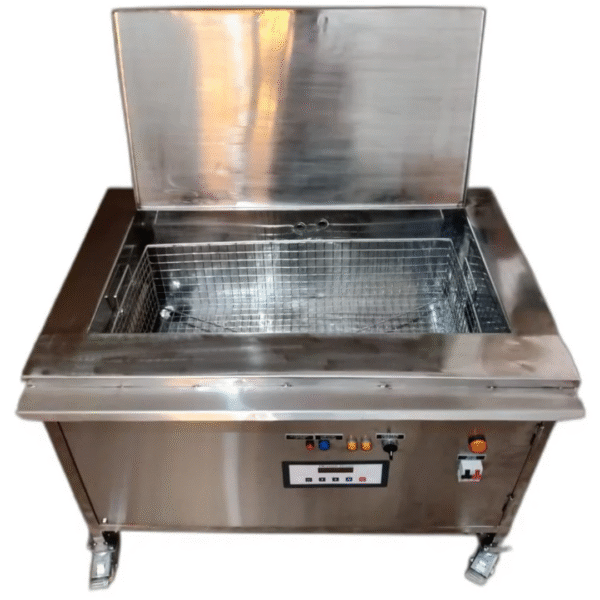
When you need to clean larger boards or higher volumes of PCBs, benchtop units fall short. Industrial single-tank machines feature heavy-duty construction, thicker stainless steel tanks, and more powerful transducers.
Key Features: Continuous operation capabilities, advanced sweep frequency functions to eliminate standing waves, and heavy-duty filtration systems.
Best For: Mid-sized electronics manufacturing plants, automotive electronics testing facilities, and aerospace repair depots.
Hisashi Solution: Hisashi Ultrasonic heavy-duty single-tank units feature premium industrial transducers that deliver consistent cavitation energy even during 24/7 manufacturing shifts.
High-reliability sectors like medical, military, and aerospace electronics require perfect cleanliness validation. A single wash tank is not enough because the cleaning fluid itself accumulates contaminants over time. Multi-stage systems solve this problem by breaking the process into distinct phases.
Stage 1: Ultrasonic Wash: The PCB undergoes intense ultrasonic cleaning in a specialized chemistry or detergent solution to break down flux and oils.
Stage 2: Ultrasonic/Bubbling Rinse: The board moves to a clean water or DI (deionized) water tank to remove residual detergent.
Stage 3: DI Water Final Rinse: A pure DI water cascade rinse ensures absolutely zero ionic contamination remains on the board.
Stage 4: Hot Air Drying: A high-efficiency drying chamber completely evaporates moisture from under components, leaving the board ready for conformal coating or testing.
Best For: High-volume, high-reliability PCB manufacturing where compliance with IPC cleanliness standards is mandatory.
Hisashi Solution: We custom-engineer automated and semi-automated multi-stage lines tailored precisely to your factory footprint and throughput requirements.
Yes. Lead-free flux requires higher soldering temperatures, which leaves behind a harder, more baked-on residue. When you combine a Hisashi Ultrasonic machine set to $60^\circ\text{C}$ with a specialized aqueous saponifying agent, even the toughest lead-free flux dissolves quickly.
Most PCBs require between 2 to 5 minutes in an ultrasonic wash cycle, depending on the severity of the flux buildup. Leaving boards in the tank for too long after they are clean adds unnecessary wear to component markings.
Yes, DI water is highly recommended. Regular tap water contains dissolved ions and minerals that remain on the circuit board after drying. These minerals form conductive pathways that cause parasitic leakage current or complete board failure down the line.
Achieving perfect cleanliness on modern printed circuit boards requires a delicate balance of power, precision, and reliability. Manual scrubbing wastes time, threatens fragile components, and leaves hidden contaminants behind.
Investing in a Hisashi Ultrasonic cleaner gives your assembly line or repair shop the ultimate competitive edge. Whether you need a compact digital benchtop system for precision rework or a fully automated, multi-stage industrial system for high-volume manufacturing, Hisashi delivers unmatched cavitation technology, durable stainless-steel construction, and expert support.
Do not let flux residue and microscopic dust compromise your electronics’ reliability. Upgrade your production line with Hisashi Ultrasonic today and experience the power of pristine cleanliness.