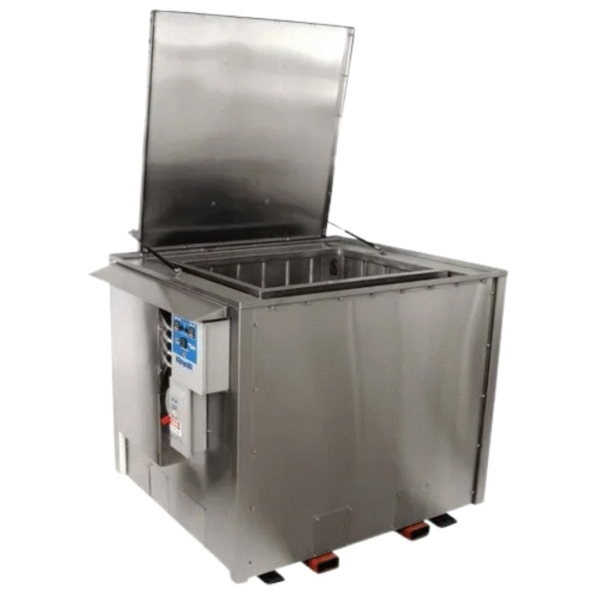
Ultrasonic Cleaner Manufacturer in Chennai
In today’s competitive industrial landscape, efficient and reliable cleaning solutions are essential for maintaining product quality, reducing downtime, and lowering costs. Ultrasonic cleaning technology has emerged as a go-to solution across sectors such as aerospace, medical, electronics, automotive, precision machining, and jewelry. As a Chennai-based manufacturer, HisashiUltrasonic is committed to delivering state-of-the-art ultrasonic cleaning systems tailored to clients’ requirements. In this blog, we explore what an ultrasonic cleaner is, types of ultrasonic cleaners, how they work, advantages, applications, selection tips, and why you should choose HisashiUltrasonic in Chennai for your ultrasonic cleaning demands.
What Is an Ultrasonic Cleaner?
An ultrasonic cleaner is a device that uses high-frequency sound waves (typically in the range of 20 kHz to 200 kHz) to create cavitation bubbles in a cleaning liquid. These bubbles collapse violently, generating micro-jets and shock waves that dislodge contaminants from surfaces—even in blind holes, crevices or micro-features.
Key components of a typical ultrasonic cleaning system include:
Tank / Chamber (usually stainless steel)
Transducer(s) bonded to or immersed in the tank walls
Generator / Power Electronics to drive ultrasonic frequency
Control System (timer, heater, mode selection)
Cleaning Solution (aqueous or solvent based)
By combining ultrasonic energy with suitable cleaning chemistry, even heavily soiled parts can be cleaned thoroughly and uniformly.
Types of Ultrasonic Cleaners
At HisashiUltrasonic, we design and manufacture a variety of ultrasonic cleaner types to suit different industries and scales. Below are common categories and their distinguishing features:
1. Bench-Top / Laboratory Ultrasonic Cleaners
These are compact ultrasonic units intended for small components, optical lenses, dental instruments, jewelry, and laboratory glassware. They often feature single or dual frequency, timer, heater and small tank capacity (0.5 L to ~10 L).
2. Industrial / Production Ultrasonic Cleaners
Large tanks (tens to hundreds of liters), robust transducers, continuous operation, power density, agitation, filtration systems, baskets and custom fixtures. Used in manufacturing lines for cleaning machined parts, molds, dies, engine components, etc.
3. Multi-Stage / Cascade Ultrasonic Systems
In more demanding cleaning workflows, items pass through multiple tanks (prewash, ultrasonic wash, rinsing, drying). The multistage design ensures each step accomplishes a targeted task (e.g. degreasing, rinse, drying). HisashiUltrasonic can supply such integrated systems.
4. Immersible / Probe Ultrasonic Systems
Here, the transducer is immersed directly into a fluid or cleaning bath, often in pipe cleaning, flow-through reactors, or custom part cleaning where full tanks are not practical.
5. Ultrasonic Spray / Jet Cleaning
Instead of fully immersing the object, ultrasonic energy is combined with sprays or jets of cleaning fluid to reach surfaces. Useful for large parts or when immersion is impractical.
6. Specialized / Custom Ultrasonic Cleaners
These include ultrasonic cleaners designed for niche applications—such as PCB cleaning, wafer cleaning in electronics, delicate optical components, semiconductor parts, and medical devices. At HisashiUltrasonic, custom design is offered to fulfill such precise requirements.
By offering a range of types, HisashiUltrasonic ensures clients get a system suited to their industry, budget, throughput, and cleanliness standard.
How Ultrasonic Cleaning Works
Understanding the mechanism can help you make better choices. Here’s a simplified breakdown:
Ultrasonic wave generation: The generator produces alternating electrical signals at ultrasonic frequencies (e.g. 25 kHz, 40 kHz).
Transduction into mechanical vibration: The transducers convert electrical energy to mechanical vibration, imparting pressure waves into the liquid.
Cavitation bubble formation and collapse: Microscopic bubbles form and collapse repeatedly. When bubbles collapse near surfaces, microjets and shockwaves dislodge contaminants.
Agitation and fluid motion: The collapsing bubbles also cause mixing and fluid flow that helps carry away loosened particles.
Cleaning chemistry effect: Surfactants, alkalines, detergents or solvents enhance removal of oils, grease, particulate matter, and residues.
Rinsing & drying stage: After ultrasonic cleaning, parts are rinsed (typically with deionized water) and dried (air, hot air, or vacuum) to remove residues.
Key parameters that influence effectiveness include frequency, power density (W per liter), temperature, duration, solution chemistry, part orientation, and ultrasonics mode (continuous, sweep, pulsed).
For example, lower frequencies (~20–30 kHz) produce stronger cavitation, suitable for robust parts with heavy contamination. Higher frequencies (40–80 kHz or more) produce gentler action, better for delicate or tiny features.
Advantages of Ultrasonic Cleaning
Why do industries increasingly adopt ultrasonic cleaning? Here are compelling benefits:
Deep, uniform cleaning: Cavitation reaches hidden surfaces, blind holes, and complex geometries.
Speed and efficiency: Faster cleaning cycles than manual or conventional methods.
Reduced labor cost: Many manual scrubbing steps can be eliminated.
Gentle yet powerful: Delicate parts can be cleaned without human abrasion.
Less chemical usage: Lower concentrations of cleaning agents are often sufficient.
Eco-friendly potential: Aqueous and biodegradable cleaning solutions can minimize environmental impact.
Repeatability & consistency: Cleaning quality can be reliably reproduced every cycle.
Scalable & modular design: Systems can be designed for small labs or large production lines.
Reduced rework and downtime: Better cleanliness reduces defects, improves yield and downstream processing.
These advantages make ultrasonic cleaning a popular choice across sectors from aerospace to jewelry to medical devices.
Applications Across Industries
Because of its versatility, ultrasonic cleaning is used in many industries. Below are prominent sectors and use cases:
1. Medical / Dental / Surgical Instruments
Surgical instruments, dental tools, endoscopes, implants, and delicate medical parts can be cleaned to remove blood, debris, sterilization residue, and biofilms. Ultrasonic cleaning is often a prerequisite before sterilization.
2. Electronics / PCB / Semiconductor
Printed circuit boards, connectors, small electronic assemblies, fine wires, soldering residues, flux remnants are thoroughly cleaned by ultrasonic systems with appropriate solvents or aqueous agents.
3. Automotive / Aerospace / Precision Machining
Engine parts, injectors, carburetors, fuel system components, hydraulic and pneumatic parts, turbine blades, gears, and molds are cleaned to remove oil, carbon, deposits, rust, fines, and debris.
4. Jewelry / Watches / Ophthalmic Lenses
Intricate jewelry pieces, watch parts, rings, eyeglass lenses, optical components are cleaned without scratching or damage.
5. Optics / Lens / Glass Components
Fiber optics, lens elements, precision glass, optical windows, mirror mounts require ultraclean surfaces; ultrasonic cleaning is ideal for reaching microstructures and eliminating micro-particles.
6. Laboratory / Research / Analytical
Glassware, lab tools, pipettes, sample holders, sensors require high purity cleansing, often in sequence with ultrapure water rinsing.
7. Industrial Manufacturing / Tooling
Molds, dies, cutting tools, stamping parts, jigs, fixtures are cleaned to maintain surface integrity, dimensional accuracy, and avoid contamination in further processing.
Because the demand is broad, HisashiUltrasonic configures systems specific to each application, ensuring optimal performance.
Conclusion
Ultrasonic cleaning is a mature, powerful, and versatile technology that can dramatically enhance cleanliness, consistency, throughput, and cost efficiency across industries. By understanding mechanisms, selecting the right type and specifications, and following best practices, one can harness its full potential.
As a trusted ultrasonic cleaner manufacturer in Chennai, HisashiUltrasonic offers tailored ultrasonic cleaning solutions—from bench-top models to large multi-stage systems—delivered with design support, quality build, and after-sales service. If you seek a partner who understands your parts, contamination, throughput, and technical constraints, HisashiUltrasonic is ready to collaborate and deliver a solution that meets your goals.
Let us help you transition from manual or conventional cleaning to ultrasonics and realize cleaner parts, higher yield, less rework, and lower cost. Contact HisashiUltrasonic today for a consultation, demo, or quote tailored to your application.