
An ultrasonic parts washer uses high-frequency sound waves — ranging from 25 kHz to 68 kHz — transmitted through a liquid solution to remove oil, grease, carbon, rust, and fine particulates from industrial components. In India, ultrasonic cleaners are used across automotive, aerospace, medical, electronics, and precision engineering industries. Hisashi Industries, based in Noida, Uttar Pradesh, manufactures custom single-stage and multi-stage ultrasonic cleaning systems with PLC/HMI automation, SS304/SS316 construction, and automatic material handling — serving industrial clients across Delhi NCR, Pune, Chennai, Bengaluru, Ahmedabad, Hyderabad, and beyond.
If your facility still relies on manual scrubbing, solvent baths, or pressure washers to clean engine components, precision moulds, or surgical instruments — you’re leaving cleanliness, efficiency, and money on the table.
India’s manufacturing sector is undergoing a quality revolution. Tier-1 automotive suppliers, aerospace subcontractors, medical OEMs, and precision engineers are all raising their cleanliness benchmarks. And ultrasonic cleaning technology is at the centre of that shift.
Hisashi Industries, headquartered in Noida, Uttar Pradesh, has been supplying engineered ultrasonic cleaning solutions to Indian industry — helping manufacturers in Delhi NCR, Pune, Chennai, Bengaluru, Ahmedabad, Hyderabad, and major industrial hubs across the country achieve contamination-free components, consistently and cost-effectively.
This guide covers everything you need to know before investing in an ultrasonic parts washer in India — from the science behind cavitation to selecting the right frequency, automation level, and system configuration for your specific process.
Ultrasonic cleaning is built on a physical phenomenon called acoustic cavitation. Here’s what happens inside the tank:
Three technical parameters drive cleaning performance:
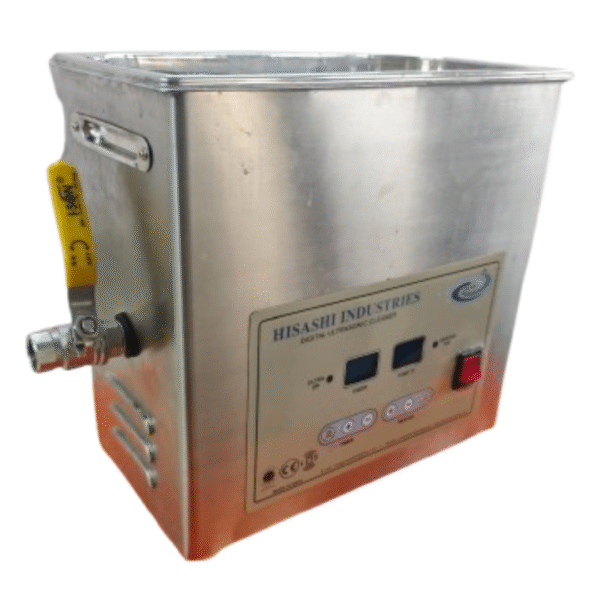
One of the most important decisions in specifying an Ultrasonic Cleaner is selecting the right operating frequency. Hisashi Industries offers five precisely engineered frequency options to match every industrial cleaning requirement:
Frequency | Best For |
25 kHz | Heavy industrial parts, castings, engine blocks, heavily carbonised components |
28 kHz | Automotive parts, carburettors, fuel injectors, hydraulic components, large metallic assemblies |
33 kHz | General engineering parts, moulds, dies, gears, bearing housings |
40 kHz | Medical instruments, dental tools, optical components, precision machined parts |
68 kHz | Electronics, PCBs, fine jewellery, semiconductor components, delicate precision parts |
Choosing the wrong frequency — too aggressive for a delicate part, or too gentle for heavy carbon buildup — directly affects cleaning quality. Hisashi’s application engineers will test your actual components and recommend the optimal frequency before any system is built.
Across India’s industrial landscape, ultrasonic cleaning has moved from a specialist tool to a manufacturing essential.
Automotive & Engine Rebuilding
Cleaning fuel injectors, carburettors, cylinder heads, brake calipers, transmission components, and EGR valves. Removes baked-on carbon deposits, varnish, and metallic swarf from precision fuel system parts without damage to sealing surfaces.
Aerospace & Defence
Turbine blades, hydraulic actuators, avionic housings, and structural fasteners require near-zero contamination tolerances. Ultrasonic cleaning with validated processes and traceability records meets the stringent requirements of DGCA, NADCAP, and AS9100-aligned production environments.
Medical & Surgical Instruments
Pre-sterilisation cleaning of surgical tools, endoscopes, dental handpieces, and orthopaedic implant components is a regulatory requirement. Indian hospitals and medical OEMs use Hisashi’s validated ultrasonic systems to meet infection control and ISO 15883 standards.
Electronics & PCB Manufacturing
Flux residue, ionic contaminants, and solder balls on PCBs are removed using 68 kHz systems with compatible, electronics-safe cleaning chemistry — without lifting components or damaging fine pitch traces.
Precision Engineering & Tooling
Injection moulds, cutting inserts, hydraulic valve bodies, and gauges are cleaned to restore surface finishes and functional precision — extending tool life and reducing scrap rates.
Jewellery Manufacturing
Ultrasonic cleaning is the gold standard in India’s jewellery sector — removing polishing compounds, wax, and investment material from intricate gold, silver, and gemstone-set pieces without mechanical contact damage.
Feature | Ultrasonic Cleaner | Pressure Washer | Manual / Solvent |
Internal cavity cleaning | Excellent | Poor | Poor |
Labour requirement | Very Low | Medium | High |
Chemical consumption | Low | Medium | High |
Cleaning consistency | High (repeatable) | Variable | Variable |
Suitable for delicate parts | Yes | No | No |
Cycle time | 5–15 minutes | Moderate | Slow |
Environmental footprint | Low | Moderate | High |
Automation capability | Full PLC/HMI | Limited | None |
For high-volume, repeatable cleaning of precision components, ultrasonic washers deliver better quality at a lower total cost of ownership than any alternative.
The right system depends on your parts, your process, and your production environment. Here are the seven factors every buyer should evaluate:
The tank must comfortably accommodate your largest component with adequate clearance for solution circulation. Hisashi builds systems from compact bench-top units to production-scale tanks exceeding 1,000 litres.
Refer to Hisashi’s frequency guide above. When in doubt, request an application trial — Hisashi will clean sample parts at different frequencies and demonstrate the results before you commit.
Manual operation is fine for low-volume or R&D cleaning. For production environments, Hisashi’s PLC and HMI-based automated systems enable programmable cycle times, temperature control, alarm management, data logging, and integration with upstream and downstream processes — eliminating operator variability and improving quality traceability.
Large or heavy components require engineered material handling solutions. Hisashi designs automatic material handling systems including basket conveyors, hoist systems, and indexed transfer mechanisms — enabling safe, ergonomic loading and unloading without manual lifting.
Depending on your application, drying options include:
Hisashi systems are built from SS304 or SS316 stainless steel, selected based on the cleaning chemistry used. SS316 is specified for aggressive acidic or high-chloride environments, offering superior corrosion resistance and a longer service life.
Hisashi Industries is based in Noida, Uttar Pradesh — strategically located to serve clients across Delhi NCR and dispatch systems pan-India. Every system is engineered, assembled, tested, and validated at the Noida facility before installation at the customer site.
Custom Engineering, Not Off-the-Shelf Every Hisashi system is designed around your specific component, contamination type, and production volume. There are no standard catalogue machines — only purpose-built solutions.
PLC & HMI-Based Automation Hisashi’s automated systems offer touchscreen HMI operation, programmable wash cycles, real-time parameter monitoring, and alarm logging — giving production managers full process visibility and control.
SS304 / SS316 Stainless Steel Construction All tanks, frames, and wetted components are fabricated from food-grade and industrial-grade stainless steel for maximum chemical resistance, hygiene, and service life.
Automatic Material Handling Systems For heavy or high-volume production applications, Hisashi integrates automated basket conveyors, overhead hoists, and transfer systems to eliminate manual handling and improve throughput.
Vacuum Cleaning and Drying For components with deep bores, blind holes, or critical moisture sensitivity, Hisashi offers vacuum-assisted cleaning and drying stages that remove trapped liquids and ensure parts emerge completely dry.
Custom Single-Stage and Multi-Stage Systems From single-tank bench units to fully automated multi-stage lines with wash, cascade rinse, DI rinse, and vacuum drying — Hisashi designs and builds the complete system under one roof.
Free Sample Cleaning Trial Before any purchase, Hisashi’s application engineers will clean your actual parts, show you the results, and recommend the optimal system configuration. No commitment required.
Hisashi Industries supplies, installs, and services ultrasonic cleaning systems across India’s key manufacturing regions:
An ultrasonic parts washer uses high-frequency sound waves (25 kHz to 68 kHz) to generate cavitation — millions of microscopic bubbles that implode on contact with component surfaces. This action removes oil, grease, carbon, rust, and fine particles from all surfaces, including internal channels, blind holes, and threads that manual or spray cleaning cannot reach.
The frequency depends on your component and contamination type. Hisashi Industries offers 25 kHz for heavy castings and engine parts, 28 kHz for automotive components and hydraulics, 33 kHz for general engineering, 40 kHz for medical instruments and precision parts, and 68 kHz for electronics and PCBs. Contact Hisashi’s application team for a free recommendation based on your sample parts.
Yes. Hisashi Industries, based in Noida, Uttar Pradesh, supplies and installs ultrasonic cleaning systems across India — including Pune, Chennai, Bengaluru, Ahmedabad, Hyderabad, Coimbatore, Ludhiana, and all major industrial cities. All systems are factory-tested before dispatch, and field engineers handle on-site installation and commissioning.
A single-stage system has one tank for ultrasonic washing — suitable for general cleaning where residual chemistry is not critical. A multi-stage system includes separate tanks for washing, rinsing (one or two stages), and drying — essential for automotive OEMs, aerospace, and medical applications with strict particle count or residue specifications. Hisashi builds both configurations, fully customized to your process.
Absolutely. Hisashi Industries offers a free sample cleaning trial at its Noida facility. Send your components, specify your contamination type, and Hisashi’s engineers will demonstrate cleaning performance, recommend the optimal frequency and configuration, and provide a detailed system proposal — with no obligation to purchase.
India’s manufacturing quality bar is rising fast — and the cleaning process is no longer an afterthought. For automotive suppliers meeting OEM cleanliness codes, medical manufacturers complying with sterilisation regulations, or aerospace subcontractors achieving near-zero contamination tolerance, the ultrasonic parts washer has become a non-negotiable part of the production process.
Hisashi Industries — based in Noida, Uttar Pradesh — brings together the engineering expertise, frequency range, automation capability, and nationwide service network to deliver the right ultrasonic cleaning solution for your exact application.
From a 25 kHz heavy-duty parts washer for a Pune automotive plant to a 68 kHz precision cleaning system for a Bengaluru electronics manufacturer — Hisashi builds it, tests it, and backs it.
Ready to clean better, faster, and smarter?
Take the first step — our application engineers will analyse your cleaning requirement, offer a free sample trial, and recommend the right system for your production environment. Free Consultation — Tell us your component, contamination, and production volume.
Call Us: +91 9871013815
Email: info@hisashiindustries.com
Hisashi Industries, Noida, Uttar Pradesh, India
Free Sample Cleaning Trial — We clean your actual parts before you decide.
Custom Machine Recommendation — No off-the-shelf solutions; every system is built for your process.
Serving: Delhi NCR · Noida · Gurgaon · Pune · Chennai · Bengaluru · Ahmedabad · Hyderabad · and all major industrial hubs across India.