
Industrial cleaning technology has evolved drastically over the last few decades. Traditional washing methods using solvent soak tanks, manual scrubbing, and high-pressure water jets often fail to deliver precision results. They leave contaminants behind in complex geometries, micro-holes, and intricate internal threads.
When absolute surface purity is non-negotiable, precision cleaning becomes a critical manufacturing standard. High-tech manufacturing sectors across Delhi, NCR, and Northern India turn to advanced Single Tank Ultrasonic Cleaners to tackle these demanding challenges.
Whether you operate a precision automotive plant in Okhla, a medical device manufacturing facility in Noida, a jewelry workshop in Chandni Chowk, or an electronics assembly hub in Gurgaon, ultrasonic cleaning delivers unmatched speed, efficiency, and cleanliness.
In this comprehensive guide, we explore the science, mechanics, industrial applications, design variations, and maintenance best practices of single-tank ultrasonic cleaning systems. We will also highlight why hisashiultrasonic stands out as a leading manufacturer of single tank ultrasonic cleaners in Delhi.
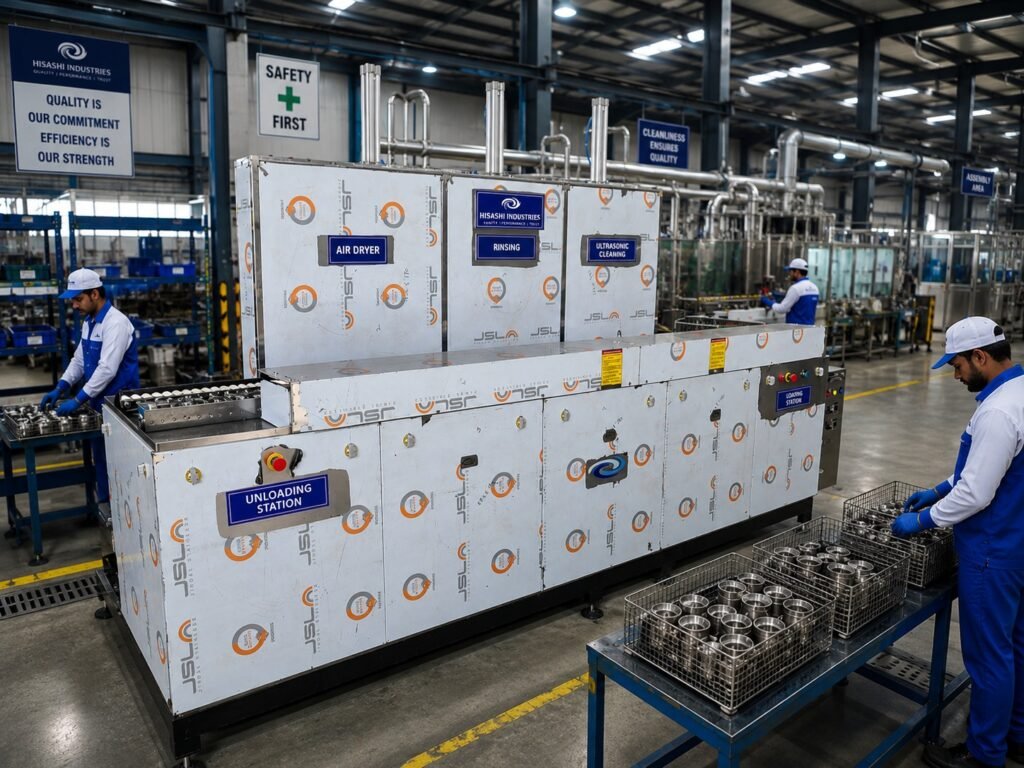
A Single Tank Ultrasonic Cleaner is a self-contained precision cleaning machine that combines high-frequency acoustic sound waves with targeted cleaning chemistry in a single stainless steel vessel.
Unlike multi-stage cleaning systems—which feature separate tanks for ultrasonic washing, rinsing, ultrasonic rinsing, warm-air drying, and rust prevention—a single tank system performs the primary deep-cleaning cycle inside a single robust chamber.
[ Ultrasonic Generator ] ---> High-Frequency Electrical Energy (28kHz - 130kHz)
                                         |
                                         v
[ Piezoelectric Transducers ] -> Mechanical Vibrations on Tank Walls/Bottom
                                         |
                                         v
[ Liquid Cleaning Solution ] -> Rapid Alternating Pressure Waves
                                         |
                                         v
[ Cavitation Bubbles Form ] ---> Explosive Implosion on Part Surface
                                         |
                                         v
                                Microscopic Scrubbing Action
Single tank ultrasonic cleaners offer a compact footprint, outstanding cleaning efficiency, and straightforward operation. They serve as the ideal workhorse for workshops, laboratories, specialized repair facilities, and medium-scale industrial production lines.
To appreciate the efficiency of a hisashiultrasonic single tank machine, you must understand the underlying physics: acoustic cavitation.
The process starts with an electronic ultrasonic generator. This unit converts standard electrical power (50 Hz / 60 Hz) into high-frequency electrical energy, typically ranging between 28 kHz and 130 kHz.
This high-frequency electrical energy feeds directly into piezoelectric transducers bonded securely to the bottom or sides of the stainless-steel cleaning tank. These ceramic elements expand and contract rapidly in response to the electric signal, transforming electrical energy into mechanical sound vibrations.
As these vibrations push into the liquid medium (usually water mixed with a small ratio of specialized aqueous chemistry), they send alternating high-pressure (compression) and low-pressure (rarefaction) sound waves shooting through the fluid.
During the low-pressure cycle, tiny vacuum voids—or microscopic vapor bubbles—form inside the liquid.
As the compression wave passes over these micro-bubbles, they rapidly collapse and violently implode. This violent collapse creates microscopic liquid jets that reach temperature hotspots of up and fluid velocities exceeding on a microscopic scale.
Because these micro-explosions occur millions of times per second throughout the fluid volume, they literally blast contaminants away from every surface contact point. The liquid penetrates deep inside blind holes, threaded regions, internal channels, and microscopic crevices that traditional brushes or pressure nozzles can never touch.
A high-performance single tank system engineered by hisashiultrasonic contains several interconnected components working in sync:
| Component | Function & Characteristics |
| Ultrasonic Tank (Basin) | Crafted from high-grade SS304 or heavy-duty SS316L stainless steel to resist cavitation erosion, chemical corrosion, and mechanical shock. |
| Ultrasonic Transducers | High-Q piezoelectric transducers that deliver maximum mechanical agitation with minimal power consumption and heat loss. |
| Solid-State Generator | The digital power pack that drives frequency tuning, output regulation, auto-degassing modes, and frequency sweep capabilities. |
| Heating System | Integrated electric immersion heaters that maintain optimal liquid to maximize chemical activity and cavitation intensity. |
| Filtration Loop (Optional) | A recirculating pump with a micronic filter cartridge that continuously removes dislodged oil and particulate debris from the bath. |
| Control Interface | Intuitive digital control panels allowing operators to configure cycle duration, target bath temperature, ultrasonic power levels, and sweep modes. |
The industrial ecosystem across Delhi-NCR—spanning Mayapuri, Naraina, Okhla, Faridabad, Gurgaon, and Ghaziabad—demands reliable equipment that handles high production throughput with low operating costs.
       +-------------------------------------------------------------+
       |           SINGLE TANK ULTRASONIC CLEANING SYSTEM            |
       +-------------------------------------------------------------+
                                      |
         +----------------------------+----------------------------+
         |                            |                            |
         v                            v                            v
  [ High Efficiency ]        [ Compact Footprint ]        [ Eco-Friendly Solution ]
  - Cuts cleaning times      - Integrates into existing   - Uses water-based solvents
    from hours to minutes      workstation setups           - Reduces chemical waste
  - Replaces hand scrubbing  - Saves valuable floor space - Protects operator safety
Manual scrubbing, dipping, and solvent spraying consume hours of skilled labor. A single-tank ultrasonic cleaner from hisashiultrasonic reduces a 45-minute manual scrubbing operation down to a 3- to 5-minute automated bath. Operators simply load parts, set the timer, and focus on other core tasks.
Manual brushes cannot reach complex internal oil channels, micro-bores, or blind holes. Ultrasonic cavitation waves travel through liquid to clean every surface point that fluid touches, delivering uniform, repeatable purity across every workpiece batch.
Not every manufacturing plant has the floor space to accommodate a multi-stage inline cleaning line. Single tank units deliver high-grade precision cleaning while occupying minimal square footage.
Modern environmental standards strictly restrict aggressive solvents like Trichloroethylene (TCE). Single tank ultrasonic systems rely primarily on water-based (aqueous) biodegradable detergents, drastically reducing hazardous chemical waste, disposal expenses, and workspace VOC emissions.
Abrasive pads, wire brushes, and high-pressure sprays can scratch precision-machined tolerances, erode thin platings, or fracture delicate micro-switches. Ultrasonic cavitation cleans gently on a microscopic scale, preserving tight geometric tolerances and fine surface finishes.
Routine maintenance preserves cleaning quality and extends the service life of your single tank ultrasonic cleaner.
+------------------+---------------------------------------------------------+
| Maintenance Cycle| Task Description                                        |
+------------------+---------------------------------------------------------+
| Daily            | • Check fluid level before operation.                   |
|                  | • Wipe down exterior splash surfaces.                   |
|                  | • Drain and replace heavily contaminated cleaning fluid.|
+------------------+---------------------------------------------------------+
| Weekly           | • Inspect interior tank walls for erosion or pitting.   |
|                  | • Clean tank bottom drains and remove sludge settlement.|
|                  | • Inspect power cables and seal gaskets.                |
+------------------+---------------------------------------------------------+
| Monthly          | • Inspect filter cartridges (if equipped with a pump).  |
|                  | • Test transducer output with a standard foil test.     |
|                  | • Check electrical connections inside the generator.    |
+------------------+---------------------------------------------------------+In modern industrial manufacturing, dirty components lead to product failures, assembly defects, and costly downtime. Investing in a high-performance Single Tank Ultrasonic Cleaner gives your production line the precision surface quality it demands.
Are you ready to optimize your cleaning process, cut turnaround times, and lower labor costs?
Contact the expert engineering team at hisashiultrasonic today to discuss your application requirements, schedule a live sample cleaning demonstration, or receive a customized quote for your facility in Delhi-NCR.