
In the modern printing and packaging industry, flexography remains one of the most dominant and efficient printing methods. From corrugated packaging and flexible pouches to pressure-sensitive labels, flexo printing delivers vivid graphics and high-speed output. However, at the very heart of every flexo press lies a critical, high-precision component: the anilox roller.
Maintaining the precise volume of ink delivered by these engraved cylinders directly impacts print quality, color consistency, and operational profitability. Over time, microscopic cell structures on anilox rollers become clogged with dried inks, coatings, resins, and polymers. Traditional or manual cleaning methods often fail to clear deep-seated debris, leading to degraded print output, unexpected downtime, and premature roller wear.
This comprehensive guide explores the technology, benefits, and industrial significance of specialized cleaning equipment, highlighting Hisashi Ultrasonics, a premier Anilox Roller Cleaning Machine Manufacturer in Noida, setting global standards for ultrasonic restoration.
To appreciate why specialized cleaning is non-negotiable, one must understand how an anilox roller functions.
+-----------------------------------------------------------------------+
|                         ANILOX ROLLER CELLS                           |
|                                                                       |
|   Clean Cell                 Partially Clogged          Fully Clogged |
|   (Optimal Ink Transfer)     (Inconsistent Color)      (Light Prints)  |
|                                                                       |
|   |  \_____/  |             |  \__*__/  |             |  \*****/  |
|   |   Ink     |             |   Ink*    |             |   Residue |
|   +-----------+             +-----------+             +-----------+   |
+-----------------------------------------------------------------------+
An anilox roller features millions of microscopic engraved cells—often made of ceramic or chrome—designed to carry a precise, measured film of ink to the printing plate. Key parameters include:
Line Screen (LPI / LPCM): The number of cells per linear inch or centimeter. Modern ceramic rollers reach up to 1,200 LPI or more.
Cell Volume : Billion Cubic Microns, representing the ink-holding capacity per unit area.
Cell Angle: Typically orientation to balance ink laydown and doctor blade interaction.
During a production run, ink dries rapidly inside these microscopic cells. Water-based, solvent-based, and UV-curable inks present unique challenges:
Water-Based Inks: Dry into tough acrylic films as amine additives evaporate.
Solvent Inks: Dry quickly, forming hard resin cakes deep within cell bases.
UV Inks: Photopolymerize when exposed to stray light or heat, forming hard plastic deposits that resist standard cleaning solvents.
When dried deposits build up, cell volume drops significantly. A drop in cell volume directly degrades color density, causes mottling, and forces operators to alter ink formulations artificially, wasting time and materials.
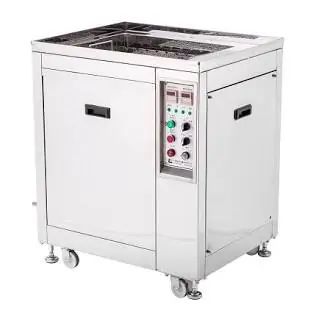
Flexo printers historically relied on manual wiping with aggressive solvents, wire brushes (brass or stainless steel), or chemical soaking. While these methods offer quick touch-ups, they carry severe operational drawbacks compared to automated ultrasonic cleaning technology developed by Hisashi Ultrasonics.
| Cleaning Parameter | Manual Scrubbing / Chemical Soaking | Ultrasonic Cleaning (Hisashi Ultrasonics) |
| Cleaning Depth | Cleans surface only; misses deep cell bases | Reaches microscopic cell bottoms completely |
| Risk of Surface Damage | High (scratching ceramic, scoring cell walls) | Zero mechanical contact; gentle micro-bubble action |
| Chemical Exposure | High risk to operator health & safety | Sealed, environmentally controlled tanks |
| Consistency | Inconsistent; dependent on human labor | 100% reproducible, automated cycles |
| Labor Efficiency | High labor hours spent scrubbing | Hands-off automated cleaning |
| Roller Lifespan Impact | Accelerates wear and shortens usable life | Extends roller operational lifespan dramatically |
High-LPI ceramic rollers feature cell openings smaller than a human red blood cell ($<20\,\mu\text{m}$). Mechanical brush bristles simply cannot penetrate these openings. Attempting to scrub deep residue forces particles deeper into cell corners or chips fragile cell walls, permanently ruining the cell geometry.
Ultrasonic cleaning harnesses high-frequency acoustic waves propagated through an engineered fluid medium. At Hisashi Ultrasonics, machines leverage precisely controlled ultrasonic frequencies to achieve deep-cleaning power without damaging delicate ceramic structures.
The fundamental physics of ultrasonic cleaning relies on acoustic cavitation:
High-Frequency Generation: Ultrasonic transducers convert electrical energy into high-frequency mechanical sound waves (typically between $28\,\text{kHz}$ and $68\,\text{kHz}$).
Pressure Wave Cycle: As these waves travel through a warm cleaning solution, alternating high-pressure (compression) and low-pressure (rarefaction) cycles form millions of microscopic vacuum bubbles.
Controlled Implosion: During high-pressure cycles, these unstable bubbles collapse inward violently—an event called implosion.
Microscopic Jet Action: Implosions generate micro-jets of fluid, extreme high temperatures (thousands of Kelvin at micro-scales), and immense localized pressure. These microscopic shockwaves break down dried resin binders and displace stubborn ink particles instantly from cell bases.
+--------------------------------------------------------------------+
|                      ACOUSTIC CAVITATION PROCESS                   |
|                                                                    |
|  1. Rarefaction Phase     2. Compression Phase     3. Implosion    |
|     (Bubble Forms)           (Bubble Compresses)      (Micro-Jet)  |
|                                                                    |
|          O                       o                   * BURST *     |
|       (Vacuum)               (Pressure)             (Debris Away)  |
+--------------------------------------------------------------------+
Because these bubbles measure only microns in diameter, they easily enter high-line-screen cells, lifting contaminants out entirely without damaging cell walls.
To maintain peak cavitation efficiency, your Hisashi Ultrasonics cleaning equipment requires routine preventative maintenance:
Regular Fluid Filtration & Replacement: Fine ink particulate settled in bath fluid dampens ultrasonic waves. Change fluids regularly and clean particle traps or cartridge filters.
Tank Bottom Inspection: Never allow heavy metal parts or sludge to rest directly on the bottom tank surface. Debris on transducer mounting plates reflects sound waves backward, causing transducer overheating.
Degassing New Solutions: Always run ultrasonic generators for 5–10 minutes after adding fresh liquid. Degassing removes trapped micro-air bubbles that cushion cavitation implosions.
Transducer Integrity Checks: Inspect transducer bonding and electrical cabling periodically for signs of chemical splashing or wear.
In modern flexographic printing, precision is everything. An uncleaned or damaged anilox roller degrades print quality, wastes expensive ink, and causes unnecessary downtime.
As a leading Anilox Roller Cleaning Machine Manufacturer in Noida, Hisashi Ultrasonics provides flexo printers, converters, and packaging plants with cutting-edge ultrasonic cleaning solutions. By harnessing engineered acoustic cavitation, controlled rotational mechanics, and industrial-grade reliability, equipment designed by Hisashi Ultrasonics restores full cell volume safely and extends roller lifespan.
Upgrading your plant maintenance with an automated ultrasonic cleaner protects your ceramic investments, maximizes press uptime, and ensures consistent print quality run after run.