
Manufacturing and precision engineering demand immaculate cleanliness. A single micro-gram of oil, grease, or particulate matter can ruin an expensive coating, break a hydraulic seal, or cause structural failure in aerospace components. Traditional manual washing, spray cabinets, and harsh solvent baths often fall short when dealing with intricate geometries, blind holes, and heavy industrial grease.
Hisashi Ultrasonic delivers precision cleaning systems designed to solve these exact challenges. Ultrasonic industrial degreasing uses high-frequency sound waves in liquid to clean parts faster, safer, and more thoroughly than conventional methods.
For decades, plants relied on three primary cleaning approaches:
Manual Solvent Immersion: Workers scrub components by hand in petroleum-based solvents. This process is labor-intensive, slow, and exposes operators to toxic Volatile Organic Compounds (VOCs).
High-Pressure Spray Washing: High-pressure jets blast surfaces clean. While effective for flat, exposed surfaces, spray jets cannot reach internal threads, deep crevices, or internal channels.
Vapor Degreasing with Chlorinated Solvents: Solvent vapors dissolve grease quickly, but strict environmental regulations (EPA, REACH) are rapidly phasing out toxic chemicals like Trichloroethylene (TCE).
Modern components — like fuel injectors, medical implants, high-precision gears, and PCB assemblies — feature complex internal geometries. Manual brushes and spray nozzles cannot physically reach these hidden areas. Surface tension prevents wash solutions from flowing into tight gaps, leaving behind residual oils that degrade product quality.
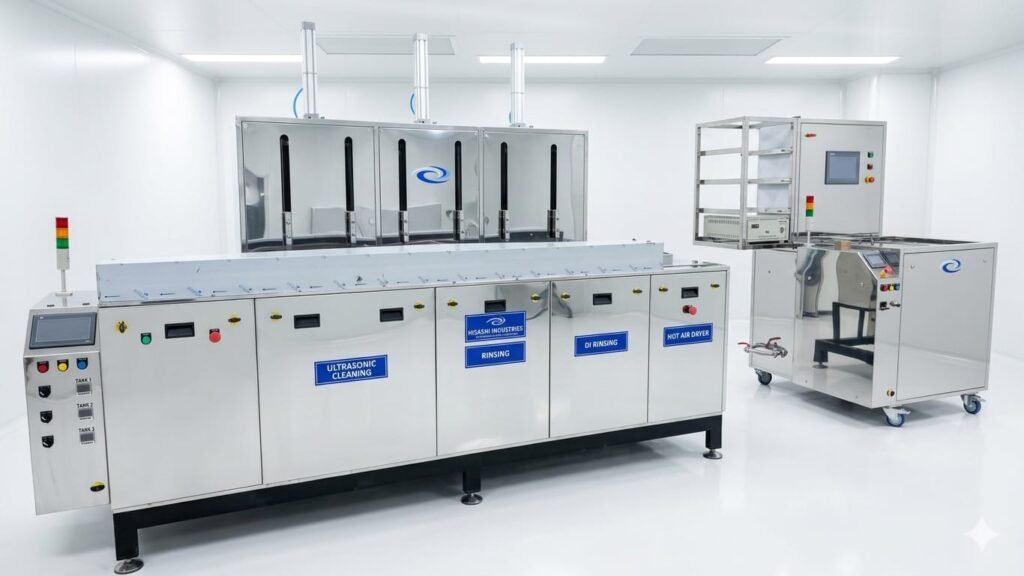
Ultrasonic degreasing relies on a physical phenomenon called acoustic cavitation. Instead of relying on brute force scrubbing or dangerous chemicals, high-frequency sound waves handle the heavy lifting.
Sound Wave Generation: An electronic generator converts standard electrical power into high-frequency electrical signals (typically between 20 kHz and 130 kHz).
Transducer Conversion: Piezoelectric transducers bonded to the bottom or sides of the stainless steel tank transform these electrical signals into mechanical vibrations.
Alternating Pressure Phases: As the transducer vibrates, it sends alternating high-pressure (compression) and low-pressure (rarefaction) acoustic waves through the liquid solution.
Microscopic Bubble Formation: During the low-pressure phase, the liquid pulls apart, creating millions of microscopic vacuum cavities (bubbles).
Implosion (Cavitation): During the high-pressure phase, these tiny vacuum bubbles collapse violently in micro-seconds.
Micro-Jet Impact: The implosion produces localized temperatures near 5,000 K and high-velocity fluid jets reaching speeds over 400 km/h. These micro-jets impact the part’s surface, scrubbing away stubborn contaminants down to the microscopic level.
Key Advantage: Cavitation occurs everywhere the cleaning liquid penetrates. If the cleaning liquid can wet a surface, the ultrasonic energy will scrub it clean — including blind holes, internal threads, and porous textures.
A high-performance ultrasonic cleaning system requires precisely matched, heavy-duty components working in tandem. Hisashi Ultrasonic builds every system with industrial-grade materials engineered for continuous 24/7 operation.
The generator serves as the brain of the machine. It converts incoming AC power into precise high-frequency electricity. High-end systems feature digital sweep frequency tracking, which continuously sweeps the frequency slightly above and below the base set point. This prevents standing waves — static zones where cleaning energy is weak — and ensures uniform cavitation across the entire tank.
Transducers turn electrical energy into mechanical sound waves.
Piezoelectric Transducers: Constructed using lead zirconate titanate (PZT) ceramic disks sandwiched between aluminum and steel masses. They deliver high energy efficiency (above 90%) and reliable long-term performance.
Immersible Transducer Packs: Sealed stainless-steel enclosures containing transducers that engineers can mount directly inside existing process tanks to convert standard tanks into ultrasonic systems.
The tank holds the cleaning solution and parts. High-performance industrial systems use heavy-gauge 316L stainless steel, which resists cavitation erosion, chemical corrosion, and high operating temperatures.
Heat significantly enhances cavitation energy and softens heavy grease. Industrial units incorporate digital temperature control systems maintaining fluids between 50°C and 70°C. Advanced systems also include continuous surface oil skimmers, particle filtration loops, and weir tanks to capture floating oil and prolong chemistry life.
Different industrial operations require tailored equipment configurations. Matching the right system architecture to your production volume prevents bottlenecks and lowers operating costs.
| Equipment Type | Best Suited For | Key Feature | Primary Advantage |
| Benchtop Units | R&D labs, electronics, small workshops | Compact all-in-one footprint | Low footprint, low initial investment |
| Single-Stage Industrial Tanks | Batch processing of medium-to-large mechanical components | Heavy-gauge 316L steel construction | Rugged durability for continuous shop-floor use |
| Multi-Stage Automated Systems | High-volume manufacturing lines | Multi-tank setup (Degrease $\rightarrow$ Rinse $\rightarrow$ Dry) | Maximum throughput with zero operator error |
| Immersible Transducer Modules | Retrofitting existing immersion or dip tanks | Modular drop-in transducer boxes | Upgrades legacy tanks without replacing infrastructure |
| Vapor-Ultrasonic Systems | Precision aerospace, optics, electronics | Closed-loop solvent vapor + ultrasonic cavitation | Zero water usage, rapid dry times, ultra-clean surface fi |
Evaluating an upgrade to ultrasonic cleaning requires comparing throughput, safety, and operating overhead against traditional methods.
       OPERATING COSTS OVER TIME

High │   [ Solvent Immersion ]  <-- High recurring solvent & disposal costs
     │   ──────────────────────────────────────────────
     │   [ Manual Scrubbing ]   <-- High direct labor costs
     │   ──────────────────────────────────────────────
Low  │   [ Hisashi Ultrasonic ] <-- Low labor, low aqueous chemistry costs
     └─────────────────────────────────────────────────
         Month 1                 Month 12               Month 24
| Metric / Feature | Manual Solvent Washing | High-Pressure Spray | Hisashi Ultrasonic System |
| Cleaning Thoroughness | Low (Limited by human reach) | Moderate (Line-of-sight only) | Exceptional (3D micro-scrubbing) |
| Cleaning Speed | Slow (15–45 mins per part) | Moderate (5–10 mins per part) | Fast (2–5 mins per batch) |
| Blind Hole Reach | Poor / Impossible | Poor | 100% Penetration |
| Operator Hazard | High (VOC inhalants, fire risk) | Medium (High noise, hot splash) | Extremely Low (Water-based) |
| Labor Cost Per Part | Very High | Moderate | Minimal (Automated batch loading) |
| Environmental Compliance | Complex (Hazmat disposal required) | Moderate (Wastewater tracking) | Simplified (Biodegradable fluids) |
When evaluating a hisashiultrasonic system for your facility in Delhi NCR, select parameters aligned with your production volume and parts geometry:
                          ULTRA-FINE CAVITATION (80 kHz)
                                   ▲
                                   │  * Micro-electronics
                                   │  * Optics & Lenses
                                   │  * Delicate Medical Tools
                                   │
                                   │  * Precision Automotive Gears
                                   │  * Machined Valves & Pistons
                                   │  * General Hardware
                                   │
                                   │  * Engine Blocks & Castings
                                   │  * Heavy Stamping Molds
                                   ▼
                          HEAVY CAVITATION (25–28 kHz)
Ultrasonic Frequencies Available: 25 kHz, 28 kHz, 40 kHz, 80 kHz, 120 kHz, or Dual/Tri-Frequency combinations.
Tank Capacities: Standard modules from 50 Liters up to 2,000+ Liters for heavy industrial parts.
Heating Capacity: Digital thermostatically controlled electric heating elements up to 80°C.
Transducer Type: High-Q Piezoelectric PZT elements bonded using high-temperature aerospace adhesives and mechanical bolting.
Automation Options: Pneumatic basket dunking, PLC-controlled overhead crane transporters, and motorized conveyor systems.
Achieving high-precision surface cleanliness across Delhi NCR’s competitive manufacturing landscape requires reliable, high-performance equipment.
A custom multi-stage ultrasonic cleaning system from hisashiultrasonic combines high-power acoustic cavitation, isolated rinse stages, oil filtration loops, and efficient drying chambers. Upgrading to a multi-stage process helps your production line eliminate reject rates, reduce labor overhead, and meet strict ISO cleanliness standards consistently.