
Cleaning industrial components, delicate instruments, and precision parts has become more challenging as manufacturing standards continue to rise. Traditional cleaning methods often fail to remove contaminants hidden in small crevices, internal channels, and complex geometries. This is where an ultrasonic cleaning machine provides a highly effective and efficient solution.
Ultrasonic cleaning technology uses high-frequency sound waves to remove dirt, grease, oil, carbon deposits, rust, and other contaminants from a wide range of materials. Industries worldwide rely on ultrasonic cleaning systems because they deliver consistent results while reducing labor costs and cleaning time.
At Hisashi Ultrasonic, we provide advanced ultrasonic cleaning solutions designed to meet the demands of modern industries. Whether you operate in automotive manufacturing, aerospace, electronics, medical equipment, or jewelry production, the right ultrasonic cleaning machine can improve cleaning quality and operational efficiency.
An ultrasonic cleaning machine is a specialized cleaning system that uses ultrasonic sound waves, typically ranging from 20 kHz to 400 kHz, to generate microscopic bubbles within a cleaning solution.
The process is known as cavitation. When these bubbles form and collapse, they create tiny yet powerful cleaning forces that remove contaminants from surfaces. Even difficult-to-reach areas can be cleaned effectively without damaging the component.
Unlike manual cleaning methods, ultrasonic cleaning delivers uniform results across every part of the object being cleaned.
The cleaning process follows several steps:
A cleaning tank is filled with water or a specially formulated cleaning solution.
Ultrasonic transducers convert electrical energy into high-frequency vibrations.
The vibrations create millions of microscopic bubbles throughout the cleaning solution.
The bubbles collapse rapidly, releasing energy that dislodges contaminants from the surface.
After cleaning, components are rinsed and dried before use or assembly.
This process ensures deep cleaning without causing abrasion or damage to sensitive parts.
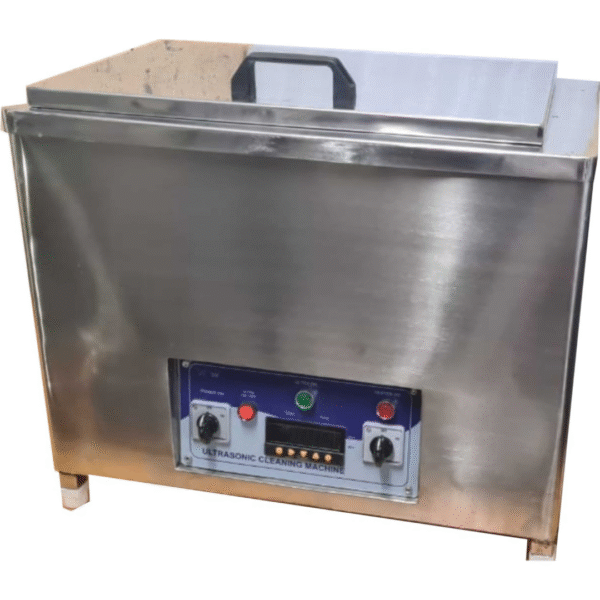
Choosing the right ultrasonic cleaning machine depends on industry requirements, component size, contamination levels, and production volume.
Benchtop models are compact systems suitable for laboratories, workshops, and small-scale operations.
Industrial ultrasonic cleaning systems are designed for heavy-duty cleaning applications.
Multi-stage systems integrate several cleaning processes within one machine.
Immersion systems are designed for large industrial tanks and specialized cleaning requirements.
Automation enhances productivity while minimizing operator involvement.
Medical-grade ultrasonic cleaners are designed for healthcare environments.
These systems help maintain hygiene standards and support sterilization processes.
Ultrasonic cleaning removes contaminants from areas inaccessible to brushes and manual tools.
Cleaning operations are completed in significantly less time compared to traditional methods.
Automation decreases manual effort while improving consistency.
Many ultrasonic cleaning systems use water-based solutions, reducing the need for harsh chemicals.
Effective cleaning prevents contamination buildup and supports equipment longevity.
Clean components contribute to better manufacturing accuracy and product reliability.
Automotive manufacturers use ultrasonic cleaning machines to clean:
Precision cleaning is essential for aerospace safety and performance.
Applications include:
Electronic components require non-destructive cleaning methods.
Ultrasonic cleaning is commonly used for:
Healthcare facilities depend on ultrasonic cleaning systems for:
Jewelry manufacturers use ultrasonic cleaning to restore shine and remove polishing residues.
Common items include:
The ultrasonic cleaning industry continues to evolve through innovation and automation.
Emerging trends include:
These advancements are helping industries achieve higher productivity while reducing operational costs.
An ultrasonic cleaning machine has become an essential tool for industries that require precision, consistency, and efficiency. From automotive manufacturing and aerospace production to medical equipment and jewelry cleaning, ultrasonic technology delivers superior cleaning results that traditional methods often cannot achieve.
Different types of ultrasonic cleaning machines are available to meet varying operational requirements, including benchtop units, industrial systems, automated solutions, immersion systems, and multi-tank configurations. Selecting the right machine depends on application needs, production volume, component size, and cleanliness standards.
Hisashi Ultrasonic remains committed to delivering high-performance ultrasonic cleaning solutions that help businesses improve productivity, reduce maintenance costs, and achieve exceptional cleaning quality. By investing in advanced ultrasonic cleaning technology, companies can enhance operational efficiency and maintain the highest standards of cleanliness across their production processes.